
Cheapest Cars to Insure for Teens: Safe and Practical Choices
The cheapest cars to insure for teens are usually not sports cars, luxury vehicles, or oversized trucks. A better strategy is to compare safe, practical vehicles with reasonable repair costs, strong crash-test performance, and insurance-friendly features before buying.
Why the Car Matters So Much for Teen Insurance
If you are under 20 and shopping for your first car, the vehicle you choose can affect your monthly insurance bill for years. Insurers often price teen drivers higher because they have less experience, but the car itself also matters. Repair cost, theft risk, vehicle value, horsepower, safety features, and how often similar vehicles generate claims can all affect the premium.
IIHS and Consumer Reports explain that for teenagers, immaturity and inexperience make driving especially risky, so choosing a safe vehicle is important. Their teen vehicle recommendations include used and new vehicles that meet safety, handling, braking, and crash-test criteria. [1]
That is why a teen should compare insurance quotes before buying the vehicle. A car with a cheap purchase price can still be expensive to insure, while a slightly more practical sedan or small SUV may be easier to cover. Young drivers can also review affordable young driver insurance options before choosing a car.
Safety first
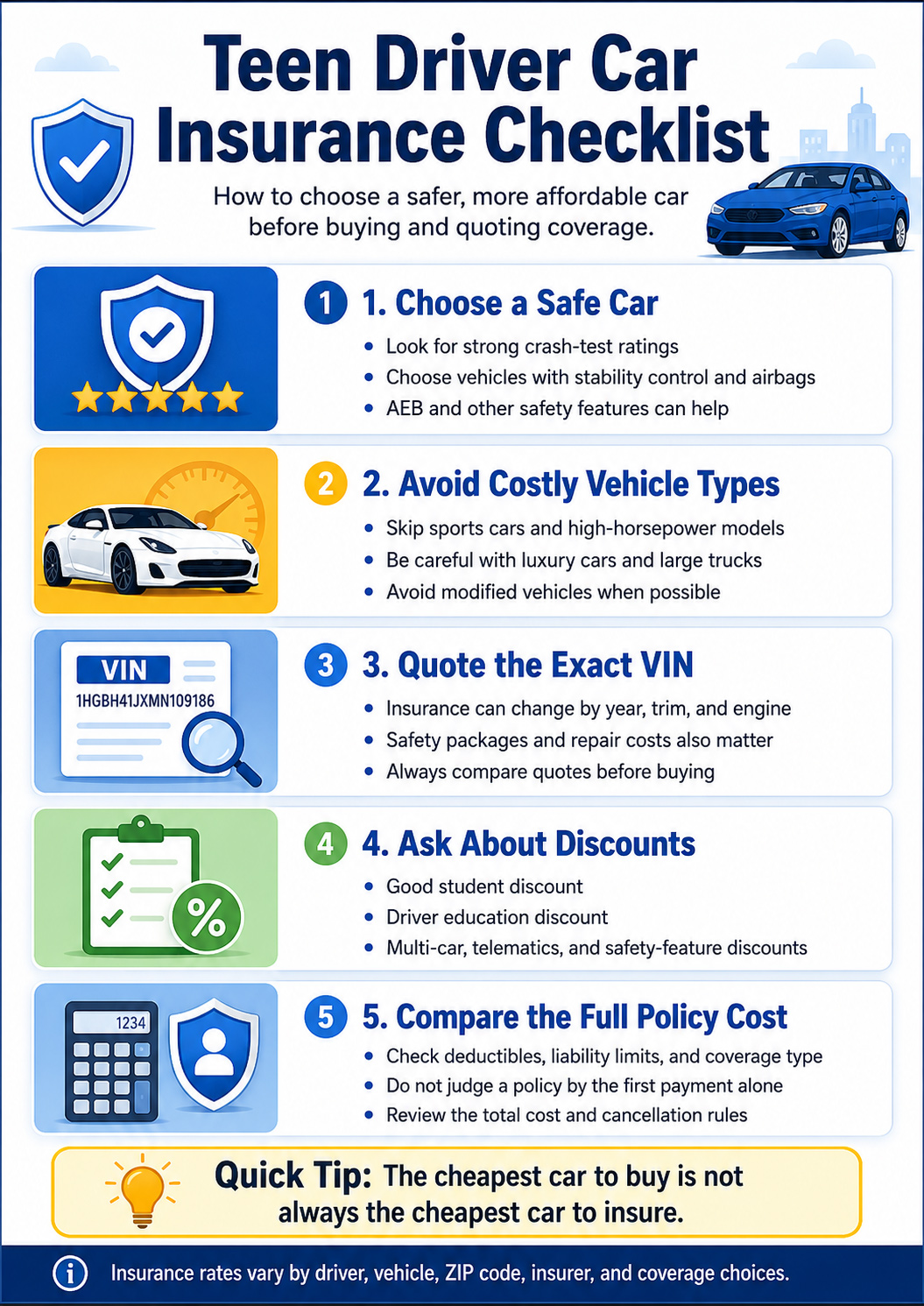
Look for good crash-test performance, electronic stability control, airbags, automatic emergency braking, and strong headlights where available.
Insurance cost second
Ask for quotes using the exact year, make, model, trim, and VIN before buying.
Avoid flashy risks
High-horsepower sports cars, luxury models, and expensive-to-repair vehicles usually work against a teen’s budget.
Best Types of Cars to Insure for Teens
The best car for a teen is usually boring in a good way: safe, predictable, reliable, affordable to repair, and not built for speed. Insurers may charge more for vehicles that cost more to repair or replace, higher-value cars, often-stolen cars, sports cars, and vehicles with special features that increase repair costs. [2]
| Vehicle Type | Why It Can Work for Teens | What to Watch |
|---|---|---|
| Compact or midsize sedan | Often practical, fuel-efficient, easier to park, and cheaper to repair than luxury or performance models. | Do not choose a very old model without modern safety features. |
| Small SUV or crossover | Can offer good visibility, practical cargo space, and strong safety ratings in many models. | Compare repair costs, AWD systems, and comprehensive premiums. |
| Midsize car | Can provide stronger occupant protection than very small cars while staying practical. | Insurance varies by model, trim, engine, and claims history. |
| Hybrid sedan or hatchback | Often practical and fuel-efficient, and some models appear on teen-safe vehicle lists. | Battery, sensor, and repair costs can vary by model year. |
| Older paid-off vehicle | May allow families to consider liability-only coverage if they can afford to replace the car. | Do not sacrifice crash protection just to lower premiums. |
Check safety ratings, open recalls, insurance quotes, repair costs, theft history, and whether the teen will be the primary driver on the family policy.
Teen-Friendly Used Cars to Compare
The models below are not a promise of the lowest premium in every ZIP code. They are practical examples from IIHS/Consumer Reports teen vehicle recommendations or common mainstream categories that are often worth quoting. Always compare the exact VIN because trim, engine, model year, safety features, and state can change the price.
| Vehicle | Why It May Be Worth Comparing | Insurance Note |
|---|---|---|
| Toyota Corolla sedan | Practical small sedan with strong reputation for reliability and available safety features in newer years. | Often a sensible teen option, but quote the exact year and trim. |
| Honda Civic sedan or hatchback | Common, efficient, and widely available with good safety options in many years. | Avoid performance trims if the goal is lower insurance. |
| Mazda 3 sedan or hatchback | Appears in IIHS teen vehicle recommendations for certain model years and offers practical size. | Compare sedan vs. hatchback and check safety equipment. |
| Toyota Camry | Midsize sedan with practical family use and strong safety history in many years. | May cost more than a compact but can offer stronger occupant protection. |
| Honda Accord | Midsize sedan with broad availability and strong safety options in many years. | Quote the exact trim because higher trims can cost more. |
| Subaru Legacy | Practical midsize sedan with available AWD in many years. | AWD can be useful, but repair and comprehensive costs may vary. |
| Subaru Outback | Practical wagon/crossover option appearing in teen-safe vehicle recommendations for certain years. | Good to compare for families wanting cargo space without a large SUV. |
| Subaru Forester | Small SUV/crossover with practical visibility and utility. | Compare model years carefully because safety ratings can change. |
| Mazda CX-5 | Small SUV often considered for safety, practicality, and family use. | Quote with collision and comprehensive if financed or higher value. |
| Honda CR-V | Common compact SUV with practical ownership costs and wide availability. | Insurance varies by generation, trim, theft risk, and location. |
Cars Teens Should Be Careful With
The most expensive cars for teen drivers are usually not hard to guess. Fast, flashy, rare, expensive, or high-repair-cost vehicles can push premiums up quickly. A teen might love the car, but the insurance bill may make the total cost unrealistic.
| Vehicle Category | Why It Can Cost More | Better Approach |
|---|---|---|
| Sports and muscle cars | High horsepower and performance branding can signal higher risk and higher repair costs. | Choose a regular sedan, hatchback, or small SUV instead. |
| Luxury cars | Parts, sensors, labor, and body repairs can be expensive. | Compare a mainstream model with similar safety features. |
| Large pickups | Higher value, size, repair costs, and liability exposure can increase premiums. | Only choose one if the teen truly needs it and the insurance quote is manageable. |
| Very old cars | May lack modern crash protection, stability control, side airbags, or driver-assistance features. | Do not buy an unsafe car just because it is cheap. |
| Modified cars | Aftermarket parts, tuning, lift kits, or performance changes can complicate underwriting and claims. | Keep the vehicle stock, practical, and easy to insure. |
How Insurers Price Teen Car Insurance
Teen insurance is expensive because several risk factors often appear at the same time: limited experience, higher crash exposure, new-car shopping mistakes, and sometimes a lack of prior coverage. The NAIC Auto Insurance Shopping Tool explains that age, years of driving experience, driving record, annual mileage, garaging address, vehicle type, limits, deductibles, and discounts can all affect premiums. [3]
Common teen insurance rating factors
- Age and years of driving experience.
- Driving record, tickets, accidents, and claims history.
- Whether the teen is the principal driver of a vehicle.
- Vehicle year, make, model, trim, value, and safety equipment.
- Annual mileage and whether the car is used for school or work.
- ZIP code, garaging address, traffic density, theft risk, and claim patterns.
- Coverage limits, deductibles, collision, comprehensive, and optional coverages.
- Available discounts, including good student, driver education, and bundling.
New Cars vs. Used Cars for Teen Drivers
A used car is not automatically cheaper to insure, and a new car is not automatically a bad idea. The right answer depends on purchase price, safety features, repair costs, financing, insurance quote, and whether the family can afford a claim deductible.
| Choice | Potential Advantage | Potential Problem |
|---|---|---|
| Older used car | Lower purchase price and possible liability-only strategy if paid off. | May lack modern safety features or have higher repair uncertainty. |
| Newer used car | May balance price, safety features, and repair reliability. | Full coverage may still be expensive for a teen. |
| New car | Modern safety tech, warranty, and fewer maintenance surprises. | Higher vehicle value usually means higher collision and comprehensive cost. |
| Financed or leased car | May allow access to a safer, newer vehicle. | Lender or lease usually requires collision and comprehensive coverage. |
Quote insurance before signing for the vehicle. A monthly car payment that looks affordable can become too expensive once teen insurance is added.
How to Get the Cheapest Teen Car Insurance
Teen drivers can lower costs by combining several strategies. No single discount fixes everything, but a safer vehicle, family policy, clean record, good student discount, and smart deductible can make a major difference.
Teen insurance savings checklist
- Choose a safe, practical vehicle before shopping for quotes.
- Ask whether staying on a parent’s policy is cheaper than a separate policy.
- Compare quotes from several insurers using the same vehicle and coverage limits.
- Ask about good student, driver education, defensive driving, and student-away discounts.
- Consider telematics only after reviewing privacy rules and whether rates can increase.
- Raise deductibles only if the family can afford the out-of-pocket cost after a claim.
- Consider liability-only coverage only for an older paid-off car that the family could afford to replace.
- Avoid coverage lapses by starting the new policy before canceling the old one.
For broader savings ideas, compare young American car insurance options and check whether the same coverage costs less with another insurer.
Deductibles, Liability-Only Coverage, and Full Coverage
The NAIC says drivers may reduce auto insurance costs by raising deductibles on collision and comprehensive, but they should first make sure they can afford a larger out-of-pocket loss after an accident. It also says drivers may consider lowering or eliminating physical damage coverage on older vehicles unless a lienholder requires it. [4]
| Strategy | When It May Help | Risk to Consider |
|---|---|---|
| Higher deductible | May lower collision or comprehensive premiums. | The teen or family pays more after a covered claim. |
| Liability-only policy | May fit an older paid-off car with low value. | The teen’s own car may not be covered after an at-fault crash, theft, hail, or vandalism. |
| Full coverage | Often needed for financed, leased, newer, or higher-value vehicles. | Costs more, especially for a teen driver. |
| Higher liability limits | Can better protect family assets after a serious crash. | May increase premium but can reduce financial exposure. |
Teen Car Insurance Discounts to Ask About
Discounts vary by insurer and state, but teen drivers should ask about every available option. The NAIC lists discounts that may include driver education, good student driver under age 25, airbags or safety equipment, anti-theft devices, multiple cars, and auto/home insurance with the same company. [5]
| Discount | How It May Help | What to Ask |
|---|---|---|
| Good student | May lower rates for students who meet grade requirements. | What GPA or school documents are required? |
| Driver education | May reward approved training courses. | Which course qualifies in your state? |
| Defensive driving | May help improve skills and qualify for savings. | Does online certification count? |
| Student away at school | May help if the teen is away from home and does not regularly use the car. | How far away must the school be? |
| Multi-car or multi-policy | May reduce household insurance cost. | Is bundling actually cheaper than separate policies? |
| Telematics | May reward safer driving or lower mileage. | Can the rate increase as well as decrease? |
| Safety features | May apply for vehicles with qualifying safety equipment. | Which features qualify: airbags, anti-theft, AEB, or alarms? |
Drivers looking for low upfront options can also compare cheap car insurance with no deposit, but they should confirm the full cost and cancellation rules before choosing a payment plan.
Telematics and Usage-Based Insurance for Teens
Telematics can help some careful teen drivers, but families should understand the details before enrolling. The NAIC Auto Insurance Shopping Tool says some insurers use data from an electronic device in the car, and that data may include when and how the car is driven. Rates may be lower for fewer miles, safer times of day, and safer driving patterns. [6]
Before enrolling, ask:
- What driving data will be collected?
- Can the teen’s rate increase if the score is poor?
- Does the program track phone use, speed, braking, or time of day?
- How long does monitoring last?
- Who can access the data?
- Can the family opt out later?
- Does the discount continue at renewal?
Safety Habits Matter More Than Any Discount
A cheaper car and a discount stack can help, but safe driving is the most important long-term strategy. NHTSA warns that teen driver risk is tied to factors like inexperience, distraction, speeding, passengers, seat belt use, impairment, and drowsy driving. [7]
Family safety rules for teen drivers
- No phone use while driving.
- Always wear a seat belt and require passengers to buckle up.
- Follow passenger limits and nighttime driving rules.
- Avoid speeding and aggressive driving.
- Do not drive tired, impaired, or distracted.
- Practice in rain, traffic, highways, parking, and night conditions with a responsible adult.
- Keep a clean driving record to protect future insurance rates.
How to Compare Quotes Before Buying a Teen Car
The NAIC says it is important to compare the same or similar coverage when shopping for auto insurance. For teen drivers, that means every quote should use the same driver, vehicle, ZIP code, limits, deductibles, and optional coverage. [8]
VIN quote rule
Before buying, ask insurers to quote the exact VIN. A different trim, engine, safety package, or model year can change the insurance price.
Quote checklist
- Exact year, make, model, trim, and VIN.
- Teen driver’s license status and driving history.
- Whether the teen is the principal driver.
- Garaging address and annual mileage.
- Same liability limits across all quotes.
- Same collision and comprehensive deductibles.
- Same optional coverages, such as UM/UIM, MedPay, rental, or roadside.
- Discounts included and proof required.
- Total six-month or annual cost, not just first payment.
For general teen coverage help, see young American auto insurance and compare policy structure before choosing the lowest price.
The Final Word on the Cheapest Cars to Insure for Teens
The cheapest cars to insure for teens are usually safe, practical vehicles with moderate value, reasonable repair costs, and strong safety features. A Toyota Corolla, Honda Civic, Mazda 3, Toyota Camry, Honda Accord, Subaru Legacy, Subaru Outback, Subaru Forester, Honda CR-V, or Mazda CX-5 may be worth comparing, but no model is guaranteed to be cheapest for every teen.
The smarter approach is to choose a safe vehicle, quote the exact VIN before buying, keep the teen on a family policy if it is cheaper, ask about discounts, avoid high-performance trims, and compare the full policy cost across several companies.
Simple rule
Buy the safest practical car you can afford, then compare insurance before signing. The cheapest car to buy is not always the cheapest car to insure.
Compare Quotes Before Buying a Teen Driver’s Car
Enter your ZIP code to continue comparing available auto insurance options and review quote paths that may fit your teen driver’s vehicle, coverage needs, and budget.
Frequently Asked Questions
What cars are usually cheapest to insure for teens?
Practical sedans, hatchbacks, and small SUVs with strong safety ratings and reasonable repair costs are often better choices than sports cars, luxury cars, or large trucks. Always quote the exact VIN before buying.
Should a teen drive a used car or a new car?
A newer used car can offer a good balance of safety and cost, but the right choice depends on budget, safety features, insurance quote, and whether the vehicle is financed.
Is liability-only coverage smart for a teen?
It can make sense only for an older paid-off car the family could afford to replace. If the car is financed, leased, newer, or expensive to replace, collision and comprehensive may be important.
Is it cheaper for a teen to stay on a parent’s policy?
Often, yes, but every household is different. Compare both family-policy and separate-policy quotes before deciding.
What discounts should teen drivers ask about?
Ask about good student, driver education, defensive driving, student away at school, multi-car, multi-policy, safety feature, anti-theft, telematics, paperless, and paid-in-full discounts.
References
- [1] Insurance Institute for Highway Safety and Consumer Reports, “Safe vehicles for teens.” https://www.iihs.org/ratings/safe-vehicles-for-teens ↩
- [2] National Association of Insurance Commissioners, “A Shopping Tool for Auto Insurance.” https://content.naic.org/sites/default/files/consumer-auto-shopping-tool.pdf ↩
- [3] National Association of Insurance Commissioners, “How Do Insurers Determine Auto Premiums?” https://content.naic.org/sites/default/files/consumer-auto-shopping-tool.pdf ↩
- [4] National Association of Insurance Commissioners, “Tips for Saving on your Auto Insurance.” https://content.naic.org/article/consumer-insight-tips-saving-your-auto-insurance ↩
- [5] National Association of Insurance Commissioners, “Ask About Discounts.” https://content.naic.org/article/consumer-insight-tips-saving-your-auto-insurance ↩
- [6] National Association of Insurance Commissioners, “Usage-Based Rating Factors.” https://content.naic.org/sites/default/files/consumer-auto-shopping-tool.pdf ↩
- [7] National Highway Traffic Safety Administration, “Teen Driving.” https://www.nhtsa.gov/road-safety/teen-driving ↩
- [8] National Association of Insurance Commissioners, “What Should I Look for When I Comparison Shop?” https://content.naic.org/sites/default/files/consumer-auto-shopping-tool.pdf ↩