
Comprehensive car insurance can help pay for certain damage to your own vehicle that is not caused by a collision. It is often purchased alongside collision coverage, but the two respond to different types of loss.
This page explains the events comprehensive coverage may address, the losses it generally does not cover, how deductibles affect claims, why a lender or leasing company may require physical-damage coverage, and what to compare when deciding whether the coverage fits a particular vehicle.
Quick Summary
- Comprehensive coverage generally applies to qualifying non-collision losses such as theft, vandalism, hail, fire, falling objects, flooding, glass damage, or contact with an animal.
- Collision coverage deals primarily with qualifying crash damage to the insured vehicle.
- Comprehensive coverage generally includes a deductible.
- State insurance laws generally focus on required liability coverage, while lenders and leasing companies may require collision and comprehensive on financed or leased vehicles.
- Vehicle value, deductible, premium, financing requirements, and exposure to non-collision losses can all affect whether comprehensive coverage is useful for a particular driver.
What Is Comprehensive Car Insurance?
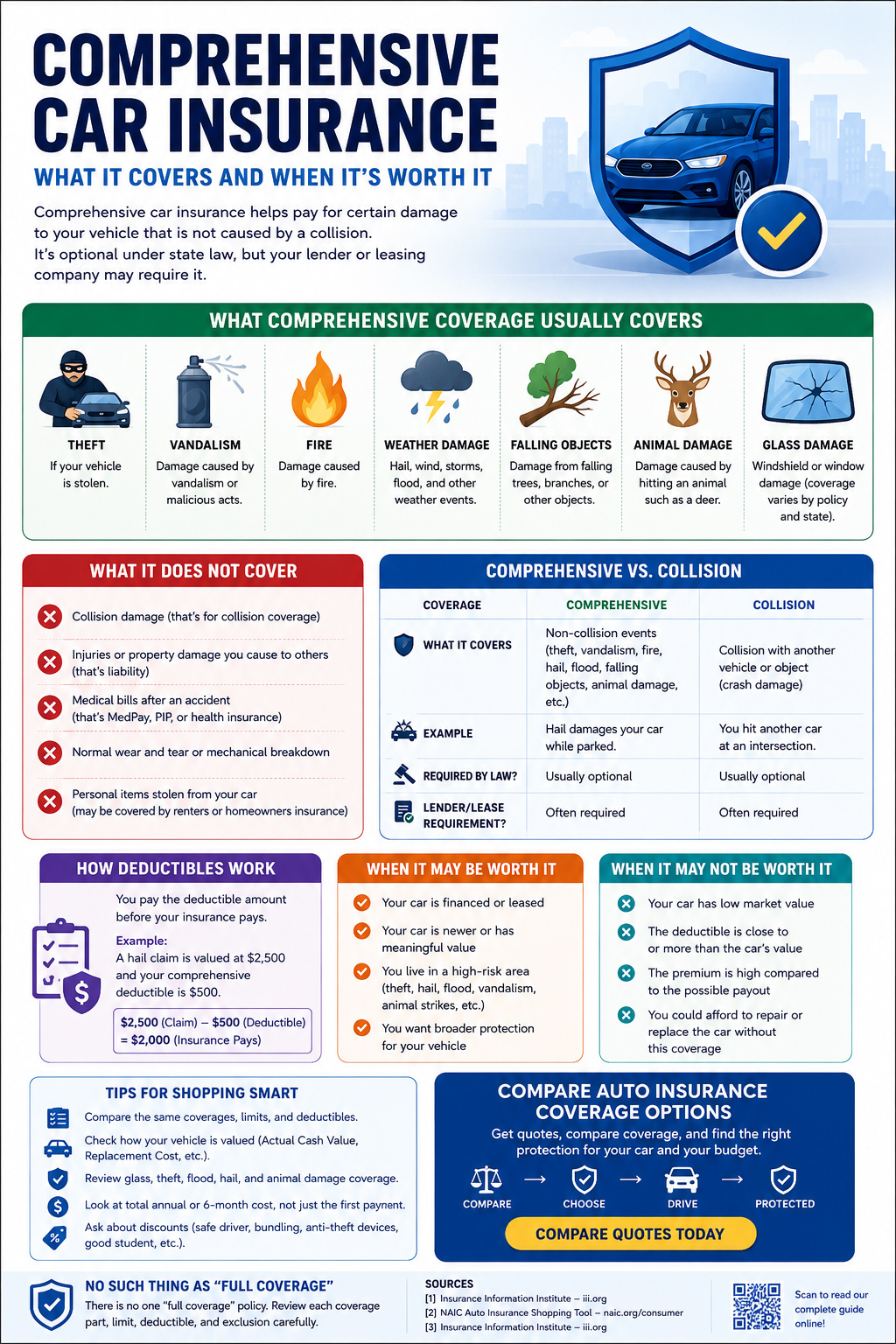
Comprehensive car insurance, sometimes described as “other than collision” coverage, applies to certain types of damage to the insured vehicle that do not result from a collision with another vehicle or object. NAIC describes comprehensive as coverage for damage to a car that is not caused by a collision. [1]
Comprehensive is only one part of an auto policy, and the distinction among liability, collision, comprehensive, and other basic auto coverages matters because each responds to a different type of financial risk.
Your own vehicle
Comprehensive generally applies to covered damage to the insured vehicle rather than another driver’s vehicle or liability claim.
Non-collision events
Common examples include theft, vandalism, weather, fire, falling objects, flooding, and certain animal-related losses.
Often optional under state law
A lender or leasing company may nevertheless require comprehensive and collision while the vehicle is financed or leased.
What Comprehensive Car Insurance May Cover
Exact policy language varies by insurer, but comprehensive coverage can apply to several common non-collision causes of loss, including fire, theft, vandalism, hail, wind, flooding, falling objects, glass damage, and animal-related damage. [2]
| Event | How Coverage May Apply | What to Confirm |
|---|---|---|
| Theft | May apply if the vehicle is stolen and the loss satisfies the policy terms. | Deductible, documentation, investigation process, and valuation method. |
| Vandalism | May apply to qualifying malicious or intentional damage caused by another person. | Documentation, police-report requirements, and exclusions. |
| Fire | May apply to qualifying fire damage to the vehicle. | Cause of loss, deductible, exclusions, and claim investigation. |
| Weather damage | May apply to hail, wind, flooding, or other qualifying weather-related vehicle damage. | Covered cause of loss, deductible, exclusions, and documentation. |
| Falling objects | May apply when a tree branch or another falling object damages the vehicle. | Cause of loss and documentation required by the insurer. |
| Animal damage | May apply to certain animal-related losses, including hitting a deer. | Whether the policy classifies the particular event as comprehensive. |
| Glass damage | May apply to windshield or window damage, depending on the policy and applicable state rules. | Glass deductible, repair rules, replacement rules, and any special state provision. |
Comprehensive does not make every non-collision event automatically covered. Deductibles, exclusions, definitions, claim requirements, and other policy conditions still apply.
What Comprehensive Insurance Generally Does Not Cover
Comprehensive coverage does not replace liability, collision, medical payments, personal injury protection, or uninsured motorist coverage. Each coverage responds to a different category of risk.
| Loss or Expense | Why Comprehensive Usually Does Not Apply | Coverage That May Be Relevant |
|---|---|---|
| Damage caused to another person’s vehicle | Comprehensive protects the insured vehicle rather than liability for damage caused to someone else’s property. | Property damage liability. |
| Injuries caused to other people | Comprehensive is physical-damage coverage for the vehicle. | Bodily injury liability. |
| Collision with another vehicle or object | Crash-related damage to the insured vehicle generally belongs under collision coverage. | Collision coverage. |
| Medical expenses after an accident | Comprehensive is not medical or injury coverage. | MedPay, PIP, health insurance, or other applicable coverage. |
| Normal wear and tear | Auto insurance generally does not pay for routine deterioration, maintenance, or ordinary mechanical failure. | Maintenance, warranty, or mechanical-breakdown protection where available. |
| Personal property stolen from the vehicle | Personal belongings inside the vehicle may not fall under auto comprehensive coverage. | Renters or homeowners coverage may apply depending on policy terms. |
Comprehensive vs. Collision Coverage
Comprehensive and collision are commonly purchased together because both protect the insured vehicle, but they respond to different causes of damage. [2]
| Coverage | General Purpose | Example |
|---|---|---|
| Comprehensive | Helps address qualifying non-collision physical damage to the insured vehicle. | Theft, hail, vandalism, fire, flood, falling objects, or animal damage. |
| Collision | Helps address qualifying crash damage to the insured vehicle. | The vehicle collides with another car, fence, pole, or object. |
| Liability | Helps address covered injury or property-damage liability to others. | An insured driver is legally responsible for damage to another person’s vehicle. |
How the Comprehensive Deductible Affects a Claim
Comprehensive coverage generally includes a deductible. Rather than thinking of the deductible as money paid directly to the insurer, it is more useful to think of it as the amount applied to the policyholder’s portion of a qualifying covered loss before the insurer calculates its covered payment.
For example, if qualifying covered damage is valued at $3,000 and a $500 comprehensive deductible applies, the deductible may reduce the amount payable under the policy. The actual settlement depends on valuation, policy terms, limits, exclusions, and the circumstances of the claim.
The amount retained by the policyholder can change substantially depending on how the deductible applies to a covered vehicle loss , so deductible options should be considered alongside both the premium and the amount of cash available after an unexpected claim.
Higher deductible
May result in a lower premium, but more of a qualifying loss remains with the policyholder.
Lower deductible
May result in a higher premium, but can reduce the policyholder’s share of a qualifying claim.
Glass provisions
Some policies or states may apply different rules to windshield or other glass losses.
A deductible that materially reduces the premium may still be a poor fit if paying that amount after a loss would create a serious financial problem.
Factors That Can Make Comprehensive Coverage More Relevant
Whether comprehensive coverage makes sense depends on the vehicle, the amount of risk retained by the driver, financing requirements, deductible, premium, and exposure to qualifying non-collision losses.
Lenders and leasing companies commonly require physical-damage coverage until the applicable financing or lease obligation ends.
Comprehensive may provide meaningful protection when replacing the vehicle without insurance would create a significant financial burden.
Theft, hail, flooding, falling trees, vandalism, or animal-related damage may increase the practical value of non-collision protection.
Coverage becomes more useful when the deductible is realistic relative to the vehicle’s value and the driver’s available savings.
When the Cost of Comprehensive Deserves a Closer Look
Comprehensive may provide less economic value when the vehicle has a low current market value, the deductible represents a large share of that value, or the premium is high relative to the potential covered payout.
That does not create one universal point at which the coverage should be dropped. The decision depends on vehicle value, financing obligations, premium, deductible, financial resources, and the driver’s willingness to absorb a total loss.
Questions to consider
- Is the vehicle financed or leased?
- What is its approximate current market value?
- How much premium is attributable to comprehensive coverage?
- What deductible applies?
- Could the vehicle be repaired or replaced without insurance proceeds?
- How significant is its exposure to theft, hail, flooding, vandalism, falling objects, or animals?
How Comprehensive Fits Into “Full Coverage”
Consumers often use “full coverage” to describe a policy containing liability, collision, and comprehensive coverage. The expression is not a standardized insurance policy name and does not mean that every possible loss is covered. [3]
Even a policy containing liability, collision, and comprehensive can include deductibles, limits, exclusions, conditions, and optional protections that are not automatically included.
The declarations page, endorsements, definitions, exclusions, and other policy provisions determine the actual protection purchased.
How to Compare Comprehensive Car Insurance Quotes
A lower quote can result from a larger deductible, different physical-damage terms, fewer endorsements, different glass provisions, or differences elsewhere in the auto policy.
Keep these details consistent when comparing quotes
- Liability limits.
- Collision coverage and deductible.
- Comprehensive coverage and deductible.
- Vehicle, drivers, garaging address, and usage.
- Whether special glass coverage or a separate glass deductible applies.
- Whether optional endorsements differ between quotes.
- How a total loss would be valued and whether any special valuation provision applies.
- Full six-month or annual policy premium.
- Whole-policy discounts and whether eligibility has been confirmed.
Anti-theft devices, multi-policy arrangements, driving programs, or other discounts may affect the overall policy premium depending on the insurer. They should not be assumed to be discounts specifically attached to comprehensive coverage.
Common Comprehensive Coverage Mistakes
| Mistake | Why It Matters | Better Approach |
|---|---|---|
| Assuming comprehensive covers every type of vehicle loss | Collision, liability, medical, and other losses involve different coverage. | Identify which coverage applies to each category of risk. |
| Removing coverage from a financed or leased car | The change may conflict with financing or lease requirements. | Confirm lender or lessor requirements before changing coverage. |
| Selecting an unaffordable deductible | A high deductible can create a large cash obligation after a qualifying loss. | Choose a deductible that fits realistic emergency savings. |
| Assuming every glass claim works the same way | Glass provisions can vary by policy and state. | Check deductible, repair, and replacement provisions. |
| Ignoring the vehicle’s current value | The economic benefit of physical-damage coverage changes as a vehicle loses value. | Compare premium, deductible, vehicle value, and financial ability to absorb a loss. |
Final Thoughts on Comprehensive Car Insurance
Comprehensive coverage protects against a different category of vehicle risk than collision or liability insurance. Its usefulness depends on the vehicle’s value, deductible, premium, financing requirements, policy terms, and exposure to qualifying non-collision losses.
Before adding, changing, or removing comprehensive coverage, compare the financial cost of the coverage with the amount of vehicle-related risk you would otherwise retain.
Simple comparison rule
Compare the comprehensive premium and deductible with the vehicle’s realistic value and the amount you could afford to lose or repair without insurance.
Compare Auto Insurance Coverage Options
Compare equivalent liability limits, physical-damage coverage, deductibles, optional protections, and total policy costs before choosing an auto insurance option.
Frequently Asked Questions
Is comprehensive car insurance required by law?
State auto insurance laws generally focus on liability or financial responsibility requirements. Comprehensive is generally optional under those laws, although a lender or leasing company may require physical-damage coverage on a financed or leased vehicle.
Does comprehensive insurance cover accidents?
Comprehensive generally addresses qualifying non-collision events. Damage caused by a collision with another vehicle or object is normally associated with collision coverage.
Does comprehensive cover theft?
Comprehensive can apply when an insured vehicle is stolen, subject to the policy’s deductible, exclusions, documentation requirements, investigation, and valuation provisions.
Does comprehensive cover hail damage?
Hail damage is commonly associated with comprehensive coverage, subject to the applicable deductible and policy terms.
Is comprehensive the same as full coverage?
No. Comprehensive is one component of an auto policy. “Full coverage” is an informal expression commonly used for liability plus collision and comprehensive, but it does not describe one standardized insurance product.
Should I keep comprehensive on an older car?
That depends on the vehicle’s value, comprehensive premium, deductible, financing status, exposure to qualifying losses, and your ability to repair or replace the car without insurance proceeds.
YoungAmericansInsurance.com publishes general educational insurance information. Comprehensive coverage, deductibles, exclusions, valuation, glass provisions, premiums, and lender requirements vary by policy, insurer, vehicle, and state. Confirm policy-specific terms with the insurer or licensed provider responsible for the coverage.