
By YoungAmericansInsurance.com Editorial Team
Published on
Updated on
Editorial details
This article was checked for collector-vehicle eligibility, valuation terminology, coverage distinctions, use restrictions, restoration considerations, quote accuracy, and source quality.
YoungAmericansInsurance.com publishes general educational information. Collector-vehicle eligibility, valuation methods, mileage restrictions, storage requirements, available coverages, deductibles, and underwriting vary by insurer and state.
Classic car insurance quotes can differ from ordinary auto insurance quotes because collector vehicles may have unusual market values, limited-use requirements, specialized repair needs, or specific storage conditions. Eligibility and policy terms depend on the insurer rather than on vehicle age alone.
When evaluating a quote, pay particular attention to the valuation method, permitted vehicle use, mileage rules, storage requirements, deductibles, exclusions, repair provisions, and the documentation used to establish the vehicle’s insured value.
What Is Classic Car Insurance?
Classic car insurance is specialty auto insurance intended for eligible collector, antique, classic, modified, exotic, or other special-interest vehicles. Triple-I notes that there is no uniform definition of a classic car, and insurer eligibility requirements can differ. [1]
Collector policies can have specialized valuation and use provisions, but they still incorporate basic auto insurance coverages and policy terms such as liability limits, deductibles, covered losses, exclusions, and policy conditions.
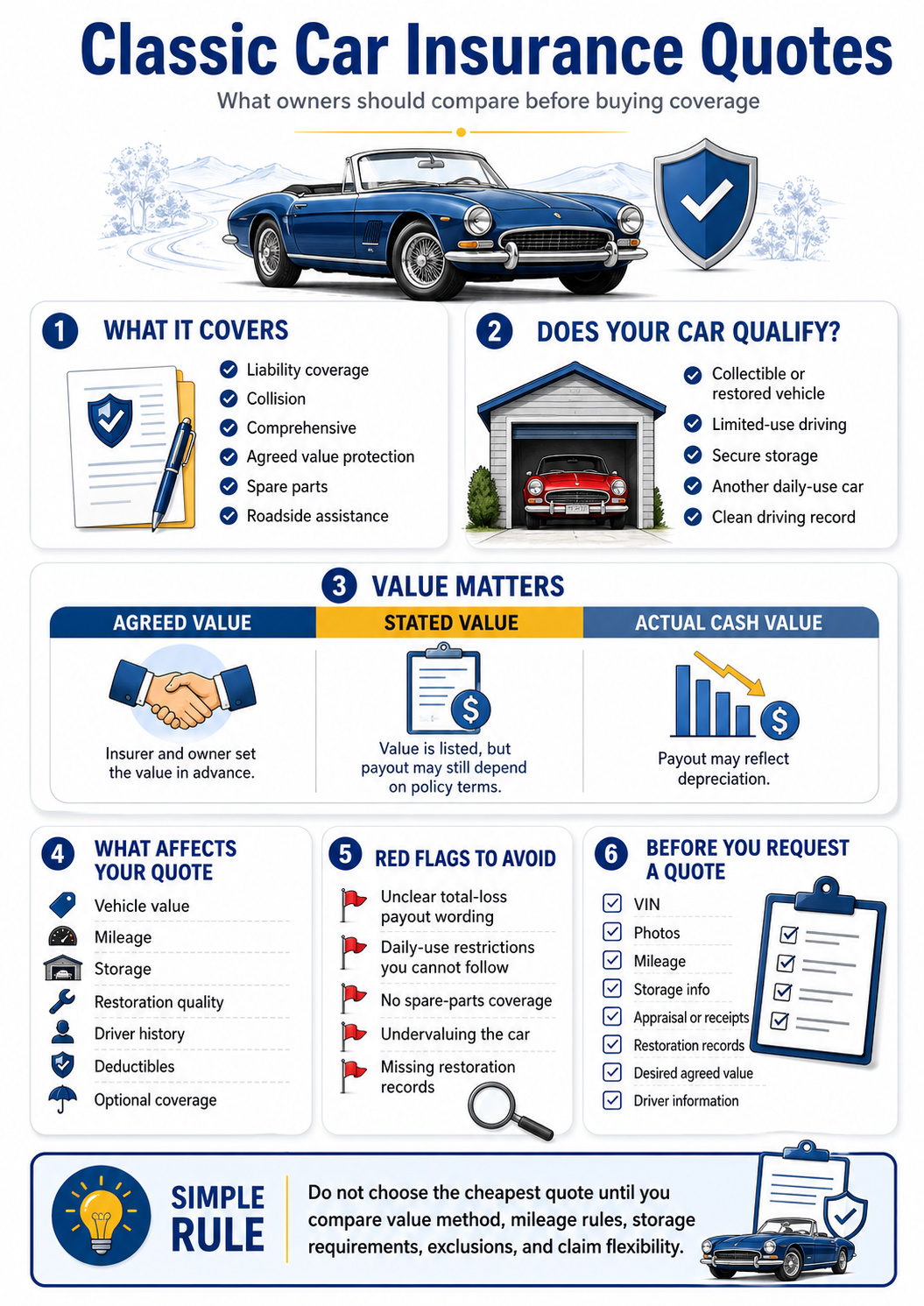
Vehicle value
Collector policies may establish an insured vehicle value differently from an ordinary auto policy.
Vehicle use
Some collector programs restrict daily commuting, regular errands, mileage, or other types of routine use.
Eligibility rules
Storage, driving history, vehicle condition, vehicle use, and access to another daily-use vehicle can affect eligibility.
Does Your Vehicle Qualify for Classic Car Insurance?
Vehicle age alone does not determine eligibility. Triple-I identifies limited use, secure storage, driving history, and in some cases access to another vehicle for everyday transportation as factors that specialty insurers may consider. [1]
| Eligibility Factor | What It Can Mean | Information That May Be Requested |
|---|---|---|
| Collector or special-interest status | The insurer determines whether the vehicle fits its collector program. | Year, make, model, condition, photographs, modifications, and other vehicle details. |
| Limited use | Everyday commuting or routine errands may not fit the program’s permitted-use rules. | Estimated mileage and a description of how the vehicle is driven. |
| Secure storage | Some programs require an enclosed or otherwise approved storage location. | Storage address and information about the garage or facility. |
| Daily-use transportation | Some insurers require access to another vehicle for regular transportation. | Information about the household’s primary-use vehicle. |
| Driving history | Serious violations can affect eligibility under some collector programs. | Accurate driver and driving-record information. |
An older vehicle used for regular transportation may not satisfy a specialty insurer’s requirements, while a younger limited-production or special-interest vehicle may qualify under another insurer’s program.
Information That May Be Needed for a Classic Car Insurance Quote
Specialty insurers may request more vehicle-specific information when they need to establish value, condition, use, or eligibility. The exact documentation varies by insurer and vehicle.
Information worth preparing
- Year, make, model, trim, VIN, and current mileage.
- Exterior, interior, engine, and storage photographs.
- Expected annual mileage and intended vehicle use.
- Storage location and relevant security information.
- The vehicle value you want the insurer to consider.
- Restoration invoices, parts receipts, or appraisal information when relevant to the vehicle’s value.
- Household driver information requested by the insurer.
- Information about another regular-use vehicle if the collector program requires it.
- Desired liability limits and applicable deductibles.
Classic Car Insurance vs. Standard Auto Insurance
A collector policy and an ordinary personal auto policy can contain many of the same basic coverage concepts, but the treatment of vehicle value, permitted use, storage, and repairs may differ.
| Feature | Standard Auto Policy | Collector Policy |
|---|---|---|
| Primary use | Commonly intended for ordinary transportation such as commuting, errands, and regular driving. | May be designed for limited or occasional collector-vehicle use. |
| Vehicle valuation | The policy may use an actual-cash-value approach for vehicle losses. | Specialty programs may offer an agreed insured value or another collector-specific valuation method. |
| Storage | Eligibility generally is not based on collector-program storage requirements. | Secure or approved storage may be an eligibility condition. |
| Repairs | Policy provisions govern repair methods, parts, and claim settlement. | Some specialty programs offer provisions intended for collector-focused repairs or difficult-to-source parts. |
These are general distinctions rather than universal rules. The policy form and endorsements determine how a particular insurer handles value, repairs, use, and claim settlement.
Agreed Value, Stated Value, and Actual Cash Value
Vehicle valuation deserves particular attention because similar-sounding terms can produce different claim outcomes. Progressive describes agreed value as an amount established between the policyholder and insurer, while stated value is an amount declared by the owner whose treatment still depends on the policy’s settlement language. [2]
| Valuation Method | General Concept | What to Confirm |
|---|---|---|
| Agreed value | The insurer and policyholder establish an insured vehicle value when the policy is written. | How the contract calculates a covered total-loss payment and whether any deductible or other adjustment applies. |
| Stated value | A value is stated for the vehicle, but the stated amount should not automatically be assumed to be the guaranteed settlement amount. | Whether the policy can settle for an amount below the stated figure and how the loss calculation is defined. |
| Actual cash value | The settlement is based on the vehicle’s value at the time of the covered loss under the policy’s valuation provisions. | How condition, market information, depreciation, modifications, and other factors are treated. |
Read the total-loss settlement provision and declarations page to determine what the listed vehicle value actually represents under the contract.
Collector Vehicle Values Can Change
Triple-I notes that classic vehicles may increase in value and recommends adjusting coverage when the insured vehicle’s value changes. [1]
Modifications, completed restoration work, condition changes, and the collector market can all be reasons to check whether the insured value still reflects the vehicle described in the policy.
Records that can help document value
- Current photographs.
- Restoration and repair invoices.
- Receipts for significant components or modifications.
- A professional appraisal when requested or useful.
- Vehicle history and authenticity documentation.
- Relevant market information for similar vehicles.
Coverage Available on Classic Car Policies
Collector policies may include familiar auto insurance coverages along with specialty options. Exact availability varies by policy, state, and insurer.
| Coverage | What It Generally Addresses | Collector-Vehicle Consideration |
|---|---|---|
| Liability | Covered bodily injury or property damage for which the insured driver is legally responsible, up to policy limits. | Applicable state requirements and selected liability limits still matter when the vehicle is driven on public roads. |
| Collision | Covered physical damage resulting from a collision, subject to policy terms. | Repair provisions can matter when specialty labor or difficult parts are involved. |
| Comprehensive | Certain covered losses other than collision, such as theft, vandalism, fire, hail, or falling objects. | Owners should understand comprehensive coverage for non-collision losses and the deductible and exclusions that apply to it. |
| Uninsured or underinsured motorist | May address certain covered losses involving an uninsured or insufficiently insured driver. | Availability and requirements differ by state and policy. |
| Spare parts | Some specialty programs provide or offer coverage for eligible spare parts. | Check the applicable limit and which items qualify. |
| Specialty towing | Some collector programs offer towing intended for specialty vehicles. | Check vehicle restrictions, towing limits, and service terms. |
Triple-I specifically identifies specialized repair or restoration, special towing, and spare-parts considerations as areas that can differ for collector vehicles. [1]
Classic Car Policy Restrictions and Exclusions to Check
Eligibility rules and claim exclusions are not the same thing. For example, secure storage may be part of underwriting eligibility, while a separate policy provision may restrict particular types of vehicle use.
| Policy Issue | Why It Matters | What to Check |
|---|---|---|
| Daily commuting | Collector programs may limit regular commuting or routine errands. | Whether the planned day-to-day vehicle use is permitted. |
| Mileage | Some programs impose mileage limits or other use conditions. | Annual mileage restrictions and any reporting requirements. |
| Shows and extended trips | Travel rules can differ among collector programs. | Whether shows, tours, club events, and multi-day trips are permitted. |
| Track or competition use | Racing or timed-event exposure may require different coverage or may be excluded. | The exact exclusion language before participating in any event. |
| Commercial activity | Business or compensated use may fall outside a personal collector policy. | Whether paid appearances, rentals, promotional use, or other commercial activity is covered. |
| Modifications | Undisclosed changes can affect value, underwriting, repairs, or eligibility. | Which modifications need to be reported to the insurer. |
Describe honestly how the vehicle will be driven and stored, then check that those activities fit the policy’s eligibility requirements and coverage provisions.
What Can Affect a Classic Car Insurance Quote?
General auto insurance pricing can reflect factors such as location, driving experience, driving record, claims history, vehicle type, vehicle use, mileage, selected coverages, and deductibles. NAIC identifies these among the primary rating considerations for auto insurance. [3]
A collector insurer may also need information specific to its specialty program, such as vehicle value, condition, permitted use, storage, or eligibility for the program. Those collector-specific requirements vary by insurer.
Quote factors to keep consistent
- Driver information.
- Vehicle year, make, model, and condition.
- Intended vehicle use and annual mileage.
- Garaging and storage information.
- Requested liability limits.
- Collision and comprehensive deductibles.
- Target insured vehicle value.
- Optional collector-specific coverages.
Classic Car Policy Terms Worth Checking Carefully
A lower premium does not necessarily mean that a quote is missing coverage, but price differences can result from different valuation methods, deductibles, liability limits, use restrictions, or optional protections.
Identify whether the contract uses agreed value, stated value, actual cash value, or another settlement method.
Determine how the insurer calculates the payment after a covered total loss.
Make sure planned driving fits the policy’s commuting, mileage, travel, and event provisions.
Confirm the type of storage required for initial and continuing eligibility.
Check how specialty shops, parts, labor, and repair decisions are handled.
Determine whether spare parts, restoration-related coverage, towing, or other collector-specific options are actually included or must be added.
Documentation That Can Support an Accurate Valuation and Quote
Documentation does not guarantee a lower premium, but it can help support the vehicle description and value presented to the insurer.
Useful records can include
- A professional appraisal when appropriate or requested.
- Current photographs of the vehicle and its condition.
- VIN and odometer information.
- Restoration invoices and parts receipts.
- Documentation for significant modifications.
- Ownership, authenticity, or vehicle-history information when relevant.
- Market information for comparable vehicles when useful to the valuation process.
Classic Cars Under Restoration
Restoration can change a collector vehicle’s condition and value over time. Some specialty insurers offer optional coverage designed for vehicles undergoing active restoration, but availability and terms are insurer-specific.
Progressive describes restoration coverage as an optional collector-policy feature that may require evidence of active restoration, such as photographs, receipts, descriptions of completed work, and project plans. [4]
| Restoration Situation | Insurance Question |
|---|---|
| Recently purchased project | What condition and value will the insurer accept when coverage begins? |
| New parts or labor added | Should the current insured value be changed as work progresses? |
| Major restoration completed | Does the existing insured value still reflect the finished vehicle? |
| Vehicle returns to road use | Do the use, mileage, driver, and storage terms need to be updated? |
Classic Car Insurance Quote Evaluation Checklist
Quotes are easier to evaluate when the underlying information is as consistent as possible. NAIC cautions that quotations may use different limits and coverages and recommends checking that the insurer or agent is properly licensed in the applicable state. [5]
Before choosing a quote
- Use the same driver and vehicle information whenever possible.
- Start with a consistent target vehicle value, then identify how each insurer defines and settles that value.
- Keep liability limits and optional coverages consistent.
- Understand how auto insurance deductibles work before changing a deductible solely to alter the premium.
- Check permitted use, mileage restrictions, and travel provisions.
- Confirm storage requirements.
- Identify whether specialty repair provisions or parts coverage are included.
- Check how restoration-related coverage works if the vehicle is an active project.
- Look at the complete policy-term premium rather than only an installment amount.
- Confirm insurer or agent licensing through the appropriate state insurance regulator.
When a Standard Auto Policy May Be a Better Fit
Not every older vehicle fits a collector-insurance program. A car used as ordinary daily transportation may conflict with a specialty insurer’s limited-use, storage, or secondary-vehicle requirements.
| Vehicle Situation | Policy Type to Investigate | Reason |
|---|---|---|
| Older vehicle used for daily commuting | Standard auto insurance | Routine use may not satisfy collector-policy eligibility rules. |
| Older vehicle without collector-program eligibility | Standard auto insurance | Age alone does not establish specialty-policy eligibility. |
| Limited-use collectible vehicle | Collector insurance may be available | Specialty eligibility, valuation, storage, and use rules can be evaluated. |
| Vehicle undergoing documented restoration | Collector program with applicable restoration options | Some specialty insurers offer coverage specifically designed for active restoration projects. |
Frequently Asked Questions
Is classic car insurance different from regular car insurance?
It can be. Collector policies may use different vehicle-valuation provisions, eligibility requirements, use restrictions, storage requirements, and specialty coverage options while still containing familiar auto insurance coverages.
How old does a car have to be for classic car insurance?
There is no single industry-wide age requirement. Insurers can consider age along with collectibility, condition, value, use, storage, and other eligibility criteria.
Can a classic car policy cover daily driving?
Some collector programs restrict everyday commuting and routine errands. Check the permitted-use and mileage provisions of the specific policy before assuming regular daily use is allowed.
What is agreed value classic car insurance?
Agreed value generally means that the insurer and policyholder establish an insured value for the vehicle. The policy’s total-loss settlement language determines how that amount is applied after a covered loss.
Is stated value the same as agreed value?
Not necessarily. A stated-value policy can use different settlement provisions from an agreed-value policy. Check whether the stated amount is a guaranteed settlement amount or a limit subject to another valuation calculation.
Can a car under restoration be insured?
Some specialty insurers offer coverage for vehicles undergoing active restoration. Eligibility, required documentation, value adjustments, limits, and availability vary by insurer.
What information may be needed for a classic car insurance quote?
An insurer may request the VIN, mileage, photographs, vehicle condition, intended use, storage information, driver details, target vehicle value, and documentation relating to restoration or significant modifications.
Should price be the only factor when choosing a classic car policy?
No. Quotes can differ in valuation method, limits, deductibles, permitted use, mileage rules, storage requirements, repair provisions, and optional specialty coverages.
Final Thoughts on Classic Car Insurance Quotes
Classic car insurance requires more than identifying an old or valuable vehicle. The insurer must determine whether the vehicle fits its collector program, how its value will be established, how it may be used and stored, and which coverage provisions apply.
Before selecting a policy, check the valuation and total-loss language, use restrictions, mileage rules, storage requirements, deductibles, specialty repair provisions, restoration options, and complete policy-term cost. Keeping the vehicle information consistent across quotes makes meaningful differences easier to identify.
This article provides general educational information about classic and collector vehicle insurance. Vehicle eligibility, valuation methods, permitted use, mileage restrictions, storage requirements, restoration coverage, deductibles, exclusions, and claim settlement provisions vary by insurer, policy, and state. The actual policy documents control coverage.
References
- [1] Insurance Information Institute, “Insuring Your Classic Car.” Triple-I ↩ ↩ ↩ ↩
- [2] Progressive, “What Is Agreed Value Insurance?” Progressive ↩
- [3] National Association of Insurance Commissioners, “Auto Insurance.” NAIC ↩
- [4] Progressive, “Does Insurance Cover Classic Car Restoration?” Progressive ↩
- [5] National Association of Insurance Commissioners, “Best Practices for Buying Auto Insurance.” NAIC ↩