
Quick answer: young drivers can often reduce car insurance costs by staying on a family policy when eligible, asking about student and driver-training discounts, choosing a practical vehicle, comparing usage-based insurance carefully, avoiding coverage lapses, and reviewing the full six-month or annual policy cost before buying.
Young Americans Insurance is an independent informational website, not an insurance carrier. Insurance rules, rates, discounts, and coverage terms vary by insurer and state, so drivers should confirm details with the licensed company, agency, or quote provider involved.
Best Affordable Car Insurance Options for Young Drivers
The right option is not always the cheapest monthly payment. A quote can look affordable because it has lower liability limits, high deductibles, missing physical damage coverage, or stricter cancellation terms. Young drivers should compare each option by price, protection, and risk.
| Option | Best For | Main Risk to Check |
|---|---|---|
| Staying on a parent or family policy | Teen or young adult drivers who live at home or qualify under household rules. | The family premium may rise, and all drivers must be listed correctly. |
| Good student discount | Students who meet grade, age, school, or documentation requirements. | Requirements vary, and proof may be needed at renewal. |
| Driver education or defensive driving discount | Newer drivers who complete an approved course. | Not every course qualifies, and some discounts are state-specific. |
| Usage-based insurance or telematics | Careful drivers, low-mileage drivers, and families willing to share driving data. | Programs may track braking, acceleration, mileage, phone use, or time of day. |
| Higher deductible | Drivers with enough savings to pay more after a covered claim. | A higher deductible can create a financial problem after an accident. |
| Practical vehicle choice | Drivers comparing cars before buying or replacing a vehicle. | A cheap car can still be expensive to insure if repairs, theft risk, or horsepower are high. |
Compare Young Driver Coverage by ZIP Code
Use the same driver, vehicle, deductible, and coverage limits when comparing quotes so the price comparison is fair.
Why Young Driver Insurance Costs More
Young drivers often pay more because insurers have less driving history to evaluate and because novice drivers can face higher crash risk. NHTSA provides teen driving safety guidance focused on common risks for novice drivers, including distraction, speeding, seat belt use, passengers, and impaired driving. [1]
Insurers may also look at vehicle type, location, coverage limits, deductibles, prior insurance history, claims, and discount eligibility. That is why one young driver may receive a much different quote than another driver of the same age.
Experience matters
New drivers usually need time to build a clean, claim-free record that insurers can price with more confidence.
Coverage matters
A cheap quote may have weak limits, high deductibles, or missing optional coverage that matters after a loss.
Discounts matter
Student, family policy, driver training, safe driver, and telematics discounts may help reduce the final cost.
Factors That Affect Young Driver Car Insurance Rates
Young driver premiums can vary widely. A driver with a clean record, a practical vehicle, access to a family policy, and strong discounts may pay much less than a driver with tickets, a high-performance car, or a coverage lapse.
| Factor | Why It Affects Cost | What Young Drivers Can Do |
|---|---|---|
| Age and driving experience | New drivers have less experience and a shorter safety record. | Drive safely, follow license restrictions, and build a clean record over time. |
| Driving record | Tickets, at-fault crashes, and claims can increase premiums. | Avoid speeding, distractions, aggressive driving, and coverage lapses. |
| Type of car | Repair costs, vehicle value, theft risk, horsepower, and safety features affect pricing. | Choose a practical vehicle with strong safety ratings and reasonable repair costs. |
| Location | ZIP code, traffic, claim frequency, theft risk, and weather can affect rates. | Use the correct garaging address and compare quotes after moving. |
| Coverage level | Higher limits and optional coverage usually cost more but can provide better protection. | Balance legal requirements, lender rules, vehicle value, and household risk. |
| Deductible | A higher deductible may lower the premium but increases claim out-of-pocket cost. | Choose a deductible you could actually pay after an accident. |
Coverage Options Young Drivers Should Compare
Affordable coverage should still be useful coverage. A low premium can become expensive if it leaves the driver exposed after an accident, theft, weather damage, or liability claim. Before cutting coverage, young drivers should understand what each coverage type does.
| Coverage Option | What It Generally Does | Why Young Drivers Compare It |
|---|---|---|
| Liability coverage | Helps pay for injuries or property damage you cause to others, up to policy limits. | Usually required by state law, but minimum limits may not be enough after a serious crash. |
| Collision coverage | Helps repair or replace your own car after a covered collision, subject to the deductible. | Often required by lenders or leases and useful for vehicles that are expensive to replace. |
| Comprehensive coverage | Helps with non-collision losses such as theft, vandalism, fire, hail, or falling objects. | Useful for newer, financed, leased, or higher-value vehicles. |
| Uninsured or underinsured motorist coverage | May help when another driver has no insurance or not enough insurance. | Can provide extra protection when another driver cannot fully pay for covered losses. |
| Medical payments or PIP | May help with accident-related medical expenses, depending on state and policy terms. | Availability and requirements vary by state, so drivers should ask how it works locally. |
Drivers who want more foundational context can also review car insurance basics and use a car insurance calculator to compare current policy costs more carefully.
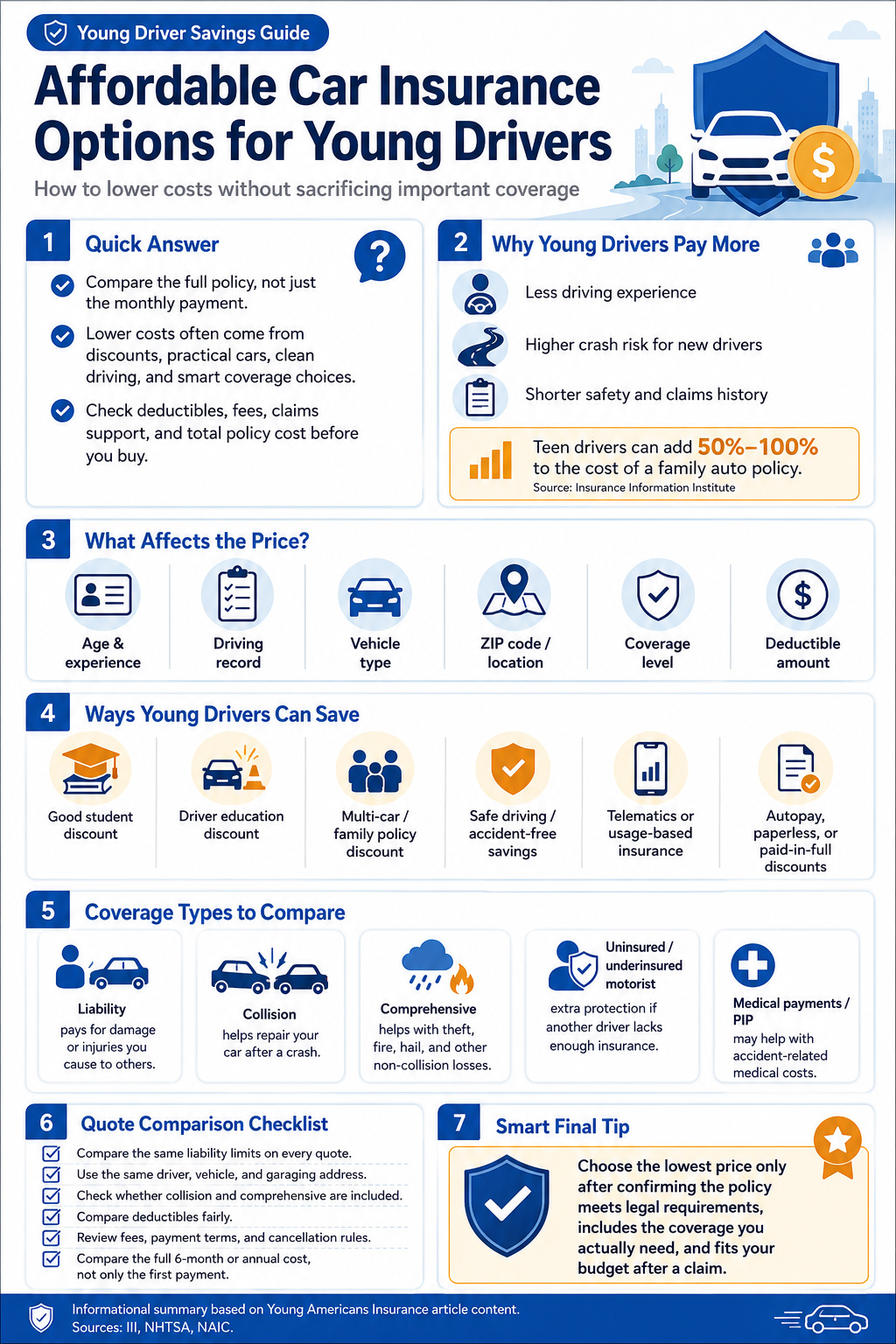
Discounts That Can Help Young Drivers Save
Discounts vary by insurer and state, but young drivers should ask about every option. A discount can lower the premium without reducing important protection. The NAIC recommends asking about discounts and comparing companies because prices and savings opportunities can differ. [2]
Discounts and savings programs to ask about
- Good student discount for eligible students who meet grade requirements.
- Driver education or defensive driving course discount.
- Safe driver or accident-free discount after a clean record period.
- Student away at school discount when the student does not regularly use the car.
- Multi-car or multi-policy discount for qualifying households.
- Anti-theft, safety feature, paperless, autopay, or paid-in-full discounts.
- Telematics or usage-based insurance discount for safe driving or lower mileage.
For shoppers focused mainly on lower upfront costs, this budget quote guide for young drivers can help compare payment and coverage trade-offs without confusing monthly price with total policy value.
Usage-Based Insurance and Telematics
Usage-based insurance can be helpful for some careful young drivers. The NAIC explains that usage-based insurance, also called telematics, works by tracking driving behavior through devices installed in a vehicle or through smartphones. [3]
Telematics may look at mileage, time of day, rapid acceleration, hard braking, cornering, phone use, or other driving patterns. It can reward safer habits, but young drivers and families should review privacy terms and pricing rules before enrolling.
Before joining a telematics program, ask:
- What data will be collected?
- Can my rate increase as well as decrease?
- How long will my driving be monitored?
- Can I opt out later?
- Who can access the driving data?
- Does the discount continue at renewal?
Choosing the Right Car for Lower Insurance Costs
The type of vehicle can make a major difference. A sporty, high-horsepower, luxury, or expensive-to-repair car may cost more to insure than a practical vehicle with strong safety features and lower repair costs.
Vehicle selection rule
Before buying a car, compare insurance quotes for that exact year, make, model, trim, and VIN if available. A car with a low purchase price can still be expensive to insure.
Young drivers should also consider whether the vehicle is financed or leased. A lender or lease company may require collision and comprehensive coverage even if the driver wants the cheapest possible policy.
Raising Deductibles Without Creating a Bigger Problem
Raising deductibles can lower premiums for collision and comprehensive coverage, but it only makes sense if the driver can afford the deductible after a claim. The NAIC advises consumers to review coverage, deductibles, and potential savings before changing physical damage protection. [4]
| Deductible Choice | Potential Benefit | Risk to Consider |
|---|---|---|
| Lower deductible | Less out-of-pocket cost after a covered claim. | Premium may be higher. |
| Higher deductible | Premium may be lower. | You pay more after a covered loss. |
| No collision/comprehensive | Premium may drop on an older paid-off car. | Your own car may not be covered after collision, theft, hail, or vandalism. |
How to Compare Quotes the Right Way
Comparison shopping is one of the best ways to find budget-friendly coverage. However, quotes must be compared fairly. A cheaper quote may simply have lower liability limits, no physical damage coverage, higher deductibles, or more restrictive payment terms.
The NAIC Auto Insurance Shopping Tool explains that shoppers should understand policy choices, gather accurate information, and compare details before buying auto insurance. [5]
Quote comparison checklist
- Use the same driver information for every quote.
- Use the same vehicle, garaging address, and estimated mileage.
- Compare the same liability limits.
- Compare the same deductibles.
- Confirm whether collision and comprehensive are included.
- Check all monthly fees, late fees, and cancellation rules.
- Compare the full six-month or annual cost, not only the first payment.
Claims Support and Policy Service
Young drivers should also compare customer service and claims support. After an accident, clear communication matters. A good claims process should explain what documents are needed, how deductibles apply, where repairs can be done, and when updates will be provided.
| Service Area | What to Ask | Why It Matters |
|---|---|---|
| Claims reporting | Can claims be reported online, by phone, through an app, or through an agent? | Fast, clear reporting helps after an accident. |
| Documentation | What photos, police reports, repair estimates, or forms are needed? | Missing documents can delay the claim. |
| Policy changes | How do I add a driver, change address, update a car, or adjust coverage? | Young drivers often change vehicles, addresses, or school status. |
| Payment support | What happens if a payment is late or fails? | A lapse can create legal and financial problems. |
For more help understanding what happens after a loss, review this guide to the insurance claims process.
Choosing a Careful Young Driver Insurance Strategy
Choosing insurance for a young driver should not be rushed. The right strategy balances affordability, state requirements, real protection, discounts, vehicle choice, and payment reliability. A policy that looks cheap but cancels quickly or leaves major coverage gaps can cost more in the long run.
Simple rule for young drivers
Choose the lowest price only after confirming the policy meets legal requirements, includes necessary coverage, fits the monthly budget, and has clear claims and cancellation rules.
Compare Budget-Friendly Young Driver Coverage
Young drivers can lower costs by comparing quotes carefully, asking about discounts, choosing practical vehicles, avoiding lapses, and building a clean driving record over time.
Frequently Asked Questions
Why is car insurance expensive for young drivers?
Young drivers often pay more because they have less experience, shorter driving histories, and higher risk indicators than more experienced drivers. Vehicle type, location, coverage level, deductibles, and driving record can also affect the final price.
Can good grades lower car insurance?
Many insurers offer good student discounts, but requirements vary. Students should ask what GPA, report card, transcript, or proof is required.
Is usage-based insurance good for young drivers?
It can help careful or low-mileage drivers, but the program details matter. Drivers should ask what data is collected, whether the premium can increase, and whether the discount continues at renewal.
Should young drivers raise deductibles?
Raising deductibles may lower premiums, but it increases out-of-pocket costs after a claim. Young drivers should only raise deductibles if they could realistically pay the higher amount.
What is the best way to find budget-friendly coverage?
Compare multiple quotes using the same coverage details, ask about discounts, choose a practical car, avoid lapses, keep a clean record, and review the full policy cost before buying.
References
- National Highway Traffic Safety Administration, “Teen Driving.” https://www.nhtsa.gov/road-safety/teen-driving ↩
- National Association of Insurance Commissioners, “Tips for Saving on Your Auto Insurance.” https://content.naic.org/article/consumer-insight-tips-saving-your-auto-insurance ↩
- National Association of Insurance Commissioners, “Understanding Usage-Based Insurance.” https://content.naic.org/article/consumer-insight-understanding-usage-based-insurance ↩
- National Association of Insurance Commissioners, “Does your vehicle have the right protection?” https://content.naic.org/article/consumer-insight-does-your-vehicle-have-right-protection-best-practices-buying-auto-insurance ↩
- National Association of Insurance Commissioners, “A Shopping Tool for Auto Insurance.” https://content.naic.org/sites/default/files/consumer-auto-shopping-tool.pdf ↩
- Insurance Information Institute, “Students.” https://www.iii.org/article/students