
By YoungAmericansInsurance.com Editorial Team
Published on
Updated on
Editorial details
This article was reviewed for New York automobile renewal, nonpayment-cancellation, insurance-lapse, DMV reporting, civil-penalty, minimum-coverage, and policy-continuity rules.
YoungAmericansInsurance.com publishes general educational information. Insurance notices, policy terms, billing procedures, reinstatement, and DMV consequences depend on the applicable policy, facts, and New York law.
A New York car insurance “renewal grace period” should not be understood as a blanket period in which a registered vehicle may be driven without active liability insurance. New York has specific rules governing renewal, cancellation for nonpayment, termination notices, and insurance lapses.
For certain covered automobile policies, New York Insurance Law § 3425 treats payment as timely when it is made to the insurer, or an authorized agent or broker, within 15 days after the insurer mails a cancellation notice for nonpayment of premium. That 15-day rule is tied to the cancellation notice; it is not simply 15 extra days after a renewal due date or policy expiration. [1]
What Is the New York Car Insurance Renewal Grace Period?
“Grace period” is convenient shorthand, but New York law is more specific. Insurance Law § 3425 defines nonpayment of premium and states that payment is timely if it is made within 15 days after mailing of a cancellation notice for nonpayment. The cancellation notice must also identify the amount due. [1]
Vehicle and Traffic Law § 313 separately provides that cancellation for nonpayment generally requires 15 days’ notice. [2]
Renewal due date
The date an insurer requests payment for the next policy period. It is not itself a universal 15-day grace-period starting point.
Cancellation notice
A notice for nonpayment identifies the amount due and an effective cancellation date under applicable New York requirements.
Insurance lapse
A lapse concerns an actual period in which a New York-registered vehicle lacks required liability insurance.
Renewal, Cancellation, Nonrenewal, and Lapse Are Different
A renewal bill, cancellation notice, nonrenewal notice, insurance ID card, and DMV insurance inquiry serve different purposes. They should not be treated as interchangeable proof that coverage is active or inactive.
The distinction is easier to follow when policy terms, coverage limits, and deductibles are kept separate from billing dates and DMV insurance-reporting requirements.
| Term | Meaning | Key Date to Check |
|---|---|---|
| Renewal | Continuation of coverage into a new policy period under the insurer’s renewal terms. | Renewal effective date and premium due information. |
| Cancellation for nonpayment | Termination based on failure to pay a required premium or installment. | Mailing date and effective date shown on the cancellation notice. |
| Nonrenewal | The insurer does not continue the policy after the current policy period. | Current policy expiration date and notice date. |
| Conditional renewal | Renewal is offered with specified changes such as limits or elimination of non-required coverage. | Notice date, renewal date, and stated policy changes. |
| Insurance lapse | A period in which a registered New York vehicle does not have the required liability insurance. | Cancellation or termination time and the next valid coverage, reinstatement, or plate-surrender date. |
New York Nonrenewal and Conditional Renewal Notices
For covered policies subject to Insurance Law § 3425, an insurer that intends not to renew a policy, or intends to condition renewal on certain coverage changes, generally must mail or deliver written notice at least 45 days but no more than 60 days before the end of the policy period. The notice must state the specific reason or reasons. [1]
If the required notice is not given in the circumstances covered by that provision, the named insured is generally entitled to renew the policy upon timely payment of the billed renewal premium, subject to the statutory terms and exceptions.
A 45-to-60-day nonrenewal or conditional-renewal notice should not be confused with the 15-day nonpayment-cancellation rules discussed above.
New York Requires Continuous Liability Insurance on Registered Vehicles
New York DMV states that required liability insurance must remain in effect while a New York vehicle registration is valid, even when the vehicle is not being driven. [3]
For a New York-registered vehicle, out-of-state insurance does not satisfy the New York insurance requirement. The applicable coverage must come from an insurer authorized to provide the required New York automobile liability coverage. [3]
Whether a vehicle may legally be operated depends on whether the required liability coverage is actually in effect, not simply on whether a bill or cancellation notice exists.
Required New York Auto Insurance Coverage
New York DFS currently lists bodily injury liability, property damage liability, basic No-Fault coverage, and uninsured motorist coverage among the required minimum automobile coverages. [4]
| Required Coverage | Minimum |
|---|---|
| Bodily injury liability | $25,000 per person / $50,000 per accident |
| Property damage liability | $10,000 per accident |
| Basic No-Fault (PIP) | $50,000 |
| Uninsured motorists | $25,000 per person / $50,000 per accident |
| Death liability | $50,000 for one person / $100,000 for two or more people |
Renewal should preserve the coverage required by New York law, while optional limits and coverages can change according to the policy, applicable notices, and selections made by the insured.
Supplemental Spousal Liability Notices at Renewal
New York’s Supplemental Spousal Liability rules changed effective March 26, 2025. For a non-commercial motor vehicle policy subject to Insurance Law § 3425, SSL is automatically included when the first named insured indicated having a spouse on the insurance application, unless the first named insured declines the coverage in writing. [5]
DFS also requires specified SSL notifications at renewal or amendment when the policy includes the coverage, and annual availability notices for applicable policies that do not already include it. The notice must identify the coverage and its premium. [5]
When the renewal price changes, check the declarations and renewal notice for changes in coverage, limits, discounts, surcharges, or applicable SSL premium rather than assuming the difference comes from one factor.
Insurance ID Cards and DMV Electronic Reporting Are Not the Same Thing
New York’s insurance system relies on electronic transactions submitted by insurers to DMV. DMV specifically states that a registrant posting proof of insurance is not a substitute for the insurer filing the required electronic insurance transaction. [6]
An insurance ID card is important evidence for the motorist, but a card, premium notice, or payment receipt should not be assumed to mean that the DMV insurance record has already been updated.
Insurance ID card
Evidence supplied to the insured for the covered vehicle and policy.
Insurer electronic filing
The insurer reports required insurance activity electronically to New York DMV.
DMV insurance record
DMV processes insurance transactions and uses them to administer registered-vehicle insurance requirements.
What Happens After a Missed Renewal or Premium Payment?
A missed due date should not automatically be described as an insurance lapse. The relevant questions are whether a valid cancellation notice has been issued, its mailing and effective dates, whether payment qualifies as timely under the applicable rule, and whether coverage actually terminates.
For a qualifying nonpayment cancellation under § 3425, the notice must state the amount due, and payment made to the insurer or an authorized agent or broker within 15 days after mailing of the notice is treated as timely. [1]
Information to verify on the notice
- The reason for cancellation.
- The amount due.
- The notice mailing date.
- The cancellation effective date and time.
- How the insurer accepts payment.
- Whether the payment prevents cancellation or follows a prior lapse.
Payment Method and Policy Status Are Separate Issues
An expired card, failed automatic draft, or bank-account problem can affect whether a premium payment is completed, but the payment method itself does not determine the legal status of the policy.
Drivers using checking-account and automatic bank payments should keep the payment authorization and policy-status questions separate: confirm whether the transaction was successful and separately confirm the policy’s actual cancellation or renewal status.
A stopped or failed bank draft should not be assumed to cancel the policy automatically, and a later successful transaction should not be assumed to erase an already-existing insurance gap unless the insurer’s records actually show continuous coverage.
How New York DMV Defines an Insurance Lapse
DMV treats a lapse as a period in which a New York-registered vehicle lacks the required liability insurance. A gap can occur between a valid cancellation or termination and later insurance, reinstatement, plate surrender, registration expiration, or another event recognized by DMV. [3]
A short lapse can affect the vehicle registration. Longer or unresolved lapses can produce additional consequences. DMV consumer materials distinguish lapses under 91 days from lapses of 91 days or more. [3]
The lapse period is based on the dates during which required insurance was not actually in effect while the vehicle remained subject to New York registration requirements.
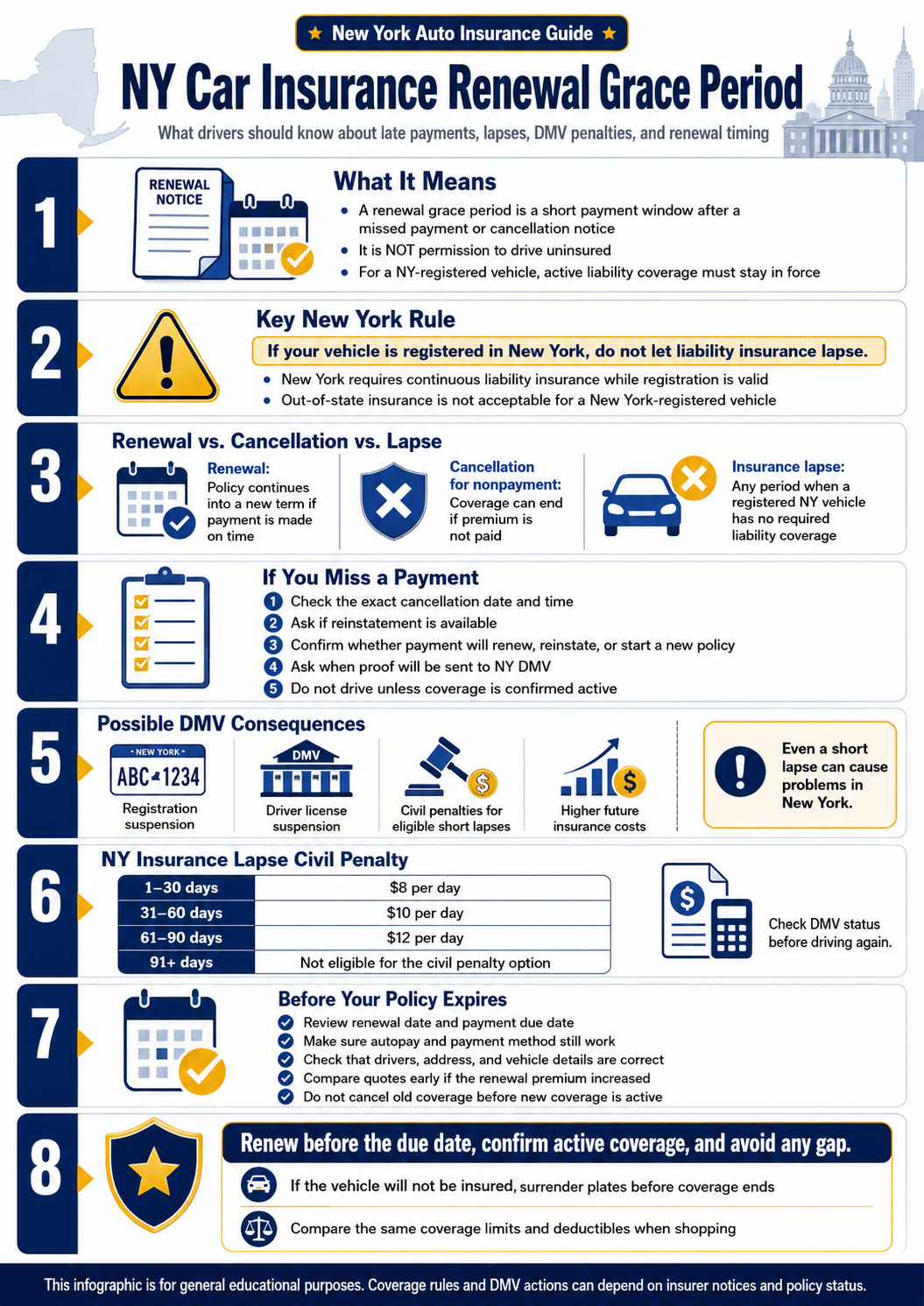
New York Insurance Lapse Civil Penalties
DMV provides an optional civil-penalty mechanism for certain insurance lapses of 90 days or less. When eligible, the registrant can pay the penalty instead of surrendering registration and plates for the lapse. DMV states that this option may be used only once during a 36-month period. [6]
| Lapse Days | Daily Rate for That Band |
|---|---|
| Days 1–30 | $8 for each day in this band |
| Days 31–60 | $10 for each day in this band |
| Days 61–90 | $12 for each day in this band |
| 91 days or more | The optional civil-penalty alternative for a lapse of 90 days or less is not available. |
The rates are progressive. For example, a 45-day lapse is not charged $10 for all 45 days: days 1–30 use the first rate and days 31–45 use the second rate. A full 90-day lapse totals $900 under the listed bands.
Registration and License Consequences of an Insurance Lapse
DMV can impose registration consequences when required liability insurance is not maintained. DMV materials also distinguish lapses of more than 90 days: when a lapse reaches 91 days or more, the plates and driver license can be subject to suspension requirements. [3]
| Situation | Possible DMV Consequence |
|---|---|
| Lapse under 91 days | Registration consequences can apply; an eligible registrant may have the civil-penalty option instead of surrendering plates. |
| Lapse of 91 days or more | DMV materials indicate that both plates and driver license can become subject to suspension requirements. |
| Driving while uninsured | Separate legal and DMV consequences can apply beyond an administrative lapse caused by registered-but-uninsured status. |
The existence of an insurance lapse should therefore not be used to infer automatically that every listed penalty applies in every case. Duration, DMV status, vehicle operation, and other facts matter.
Reinstatement Does Not Always Mean There Was No Lapse
New York DMV’s electronic reporting system distinguishes a reinstatement from a rescission of an incorrect cancellation. A reinstatement transaction restores liability insurance after a valid cancellation, and DMV compares the reinstatement effective date with the earlier cancellation date to determine whether a gap exists. [6]
That means receiving a reinstatement notice should not automatically be interpreted as proof that coverage was continuous. The effective dates reported by the insurer determine whether DMV records a lapse.
If there is a question about a prior cancellation, confirm both the insurer’s coverage dates and the DMV insurance record rather than relying only on a payment receipt.
Switching Auto Insurers at Renewal
A replacement policy must be coordinated by effective date and time, not merely by calendar date. Vehicle and Traffic Law § 313 recognizes that a new insurance contract for the same vehicle can terminate the previous contract as of the new policy’s effective date and hour. [2]
For a New York-registered vehicle, the practical issue is whether required liability insurance remains continuous. A new policy beginning later than the termination time of the prior policy can leave an actual gap even if both events occur on the same date.
Check Coverage Changes on the Renewal Documents
A renewal can involve a different premium even when the vehicle and drivers have not changed. Review the declarations and renewal materials for liability limits, optional coverages, surcharges, discounts, and deductibles rather than treating the payment amount as the only change.
If collision or comprehensive deductibles have changed, the effect is easier to evaluate when you know how an auto insurance deductible applies to a covered loss . The deductible and premium should be considered as separate parts of the renewed policy.
Renewal details worth checking
- Policy-period start and end dates.
- Renewal premium and installment schedule.
- Liability limits.
- No-Fault and uninsured motorist coverage.
- Collision and comprehensive coverage, if present.
- Applicable deductibles.
- Added or removed endorsements.
- Discounts and surcharges shown on the renewal.
- Supplemental Spousal Liability information when applicable.
If the Vehicle Will No Longer Be Insured
New York DMV instructs registrants to surrender registration and plates before required liability insurance ends when the vehicle will no longer remain insured under a valid New York registration. [3]
Simply parking the vehicle or deciding not to drive it does not by itself end the insurance requirement while the New York registration remains valid.
New York Auto Insurance Renewal Checklist
- Check the policy expiration and renewal effective dates.
- Check the premium due date and installment schedule.
- Read any cancellation, conditional-renewal, or nonrenewal notice separately from the renewal bill.
- If a nonpayment cancellation notice was issued, identify its mailing date, amount due, and effective cancellation date.
- Confirm that all drivers, vehicles, and registration information are accurate.
- Check liability limits, No-Fault, UM coverage, physical-damage coverage, and applicable deductibles.
- Check SSL information if the coverage or annual availability notice applies.
- Confirm any replacement policy’s exact effective date and time.
- Keep the required insurance ID card while recognizing that insurer electronic reporting is a separate DMV process.
- If the registered vehicle will not remain insured, check the DMV plate surrender requirements before coverage ends.
Frequently Asked Questions About NY Car Insurance Renewal Grace Periods
Does New York give a 15-day car insurance renewal grace period?
New York does not provide a blanket 15-day period to drive uninsured after a renewal due date. For certain covered auto policies, Insurance Law § 3425 treats payment as timely when it is made within 15 days after the insurer mails a cancellation notice for nonpayment.
Are the 15 days counted from the renewal due date?
Not under the § 3425 rule discussed here. The statute measures the 15-day timely-payment period from the mailing of the qualifying cancellation notice for nonpayment.
Can I drive if my New York insurance payment is late?
A New York-registered vehicle must have the required liability insurance in effect. Whether a payment is late does not by itself answer whether the policy is currently active; check the actual policy and cancellation-effective dates.
Can a one-day insurance gap matter in New York?
DMV can treat a period in which a registered vehicle lacks required liability insurance as a lapse. The consequences depend on the duration and circumstances of the lapse.
Does New York require uninsured motorist coverage?
DFS lists uninsured motorist coverage of $25,000 per person and $50,000 per accident among New York’s required minimum automobile coverages.
Can I pay a civil penalty for an insurance lapse?
DMV provides an optional civil-penalty alternative for eligible lapses of 90 days or less. The option can only be used once during a 36-month period. It is not available for a lapse of 91 days or more.
Does reinstating the policy automatically erase a lapse?
Not necessarily. DMV compares the cancellation and reinstatement effective dates. A reinstatement after the cancellation date can still leave a lapse period unless the insurer’s records establish continuous coverage.
Does an insurance ID card prove DMV has updated my coverage?
Not by itself. New York’s system also relies on electronic insurance transactions submitted by insurers. DMV states that posting proof of insurance is not a substitute for the insurer’s required electronic filing.
How should coverage be timed when switching insurers?
Check the effective date and hour of both policies. A gap can occur if the prior policy ends before the replacement policy becomes effective, even when both dates are the same.
Final Thoughts on New York Car Insurance Renewal Grace Periods
New York’s 15-day nonpayment rule should not be confused with a general grace period after policy expiration. For covered automobile policies, the statute ties timely payment to the mailing of a qualifying cancellation notice for nonpayment.
Renewal payment, cancellation, policy termination, insurer electronic reporting, and a DMV insurance lapse are separate events. The relevant dates and times determine whether required liability insurance remained continuous on a New York-registered vehicle.
This article provides general educational information about New York automobile insurance renewal, cancellation, and lapse rules. Statutory requirements, policy terms, notices, reinstatement circumstances, DMV records, and individual facts can affect a particular situation. Current requirements should be confirmed with the insurer, New York Department of Financial Services, or New York DMV when applicable.
References
- [1] New York Insurance Law § 3425, “Certain property/casualty insurance policies; cancellation and renewal provisions.” NY Senate ↩ ↩ ↩ ↩
- [2] New York Vehicle and Traffic Law § 313, “Notice of termination.” NY Senate ↩ ↩
- [3] New York State Department of Motor Vehicles, “Insurance Requirements and Insurance Lapses.” NY DMV ↩ ↩ ↩ ↩ ↩ ↩
- [4] New York State Department of Financial Services, “Automobile Insurance Coverage Checklist.” NY DFS ↩
- [5] New York State Department of Financial Services, “Insurance Circular Letter No. 2 (2025): Supplemental Spousal Liability Insurance.” NY DFS ↩ ↩
- [6] New York State Department of Motor Vehicles, “Insurance Information & Enforcement System Resource Guide.” NY DMV ↩ ↩ ↩