
By YoungAmericansInsurance.com Editorial Team
Published on
· Updated on
No-deposit car insurance generally refers to a policy marketed with a low initial payment or without a separate deposit. It should not be interpreted as a guarantee that valid auto insurance can begin with nothing due.
Coverage does not become active simply because a quote has been generated. The insurer or authorized provider must accept the application, any required initial payment or billing arrangement must be satisfied, and the policy must have a confirmed effective date and time.
Drivers whose main concern is obtaining coverage immediately while spreading later payments are dealing with a related but different question, because same-day car insurance with later installment payments involves policy timing and payment scheduling in addition to the amount due upfront.
What Does No-Deposit Car Insurance Really Mean?
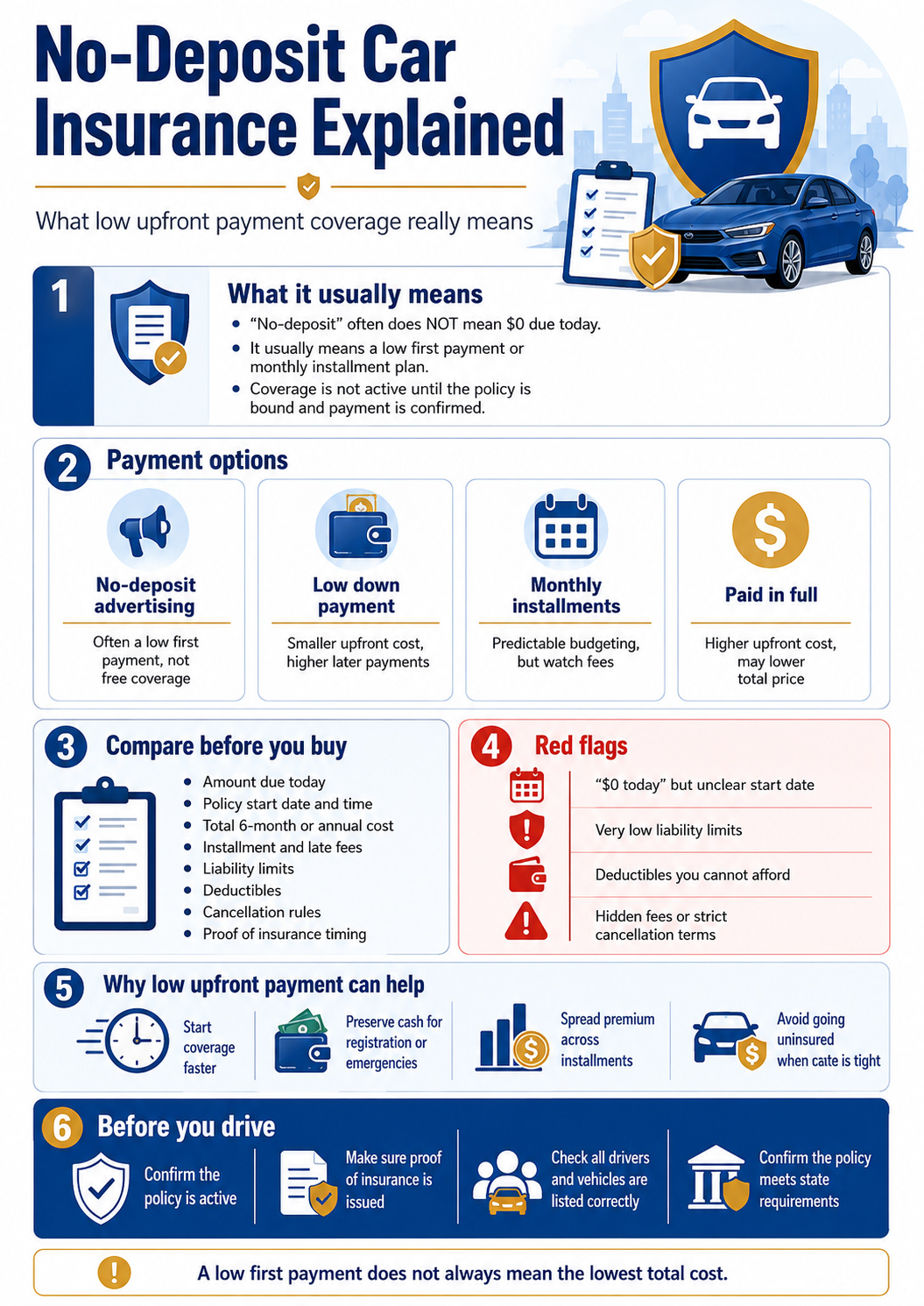
“No deposit” is commonly used as marketing language rather than as a standardized insurance term. An offer may involve a smaller first installment, no separate security-style deposit, or a payment schedule that spreads the premium across the policy term.
The important number is therefore not the word “deposit” in an advertisement. It is the actual amount that must be paid or authorized before the insurer considers the policy bound, together with the effective date, total premium, fees, limits, deductibles, and remaining payment schedule.
Lower amount upfront
A policy may require less money at the beginning while collecting the remaining premium through later installments.
No separate deposit
An advertisement may mean that there is no additional deposit beyond the first required premium payment or policy charge.
Coverage must still be active
A price estimate or completed quote form is not proof that an insurance policy has taken effect.
Confirm that the application has been accepted, the effective date and time have started, and valid proof of insurance is available before relying on the policy.
No Deposit vs. Low Down Payment vs. Paid in Full
These payment structures can affect cash flow differently even when the underlying coverage is similar. The first payment should therefore be compared alongside the complete policy-term premium and any billing charges.
| Payment Structure | How It May Work | What to Confirm |
|---|---|---|
| No-deposit advertising | May describe a low initial payment or the absence of a separate deposit. | Exact amount required to bind the policy, fees, effective time, and later installments. |
| Low down payment | A smaller portion of the premium is collected at the beginning and the balance is divided into later payments. | Whether later installments are larger and what the full policy will cost. |
| Monthly installments | The policy premium is collected through scheduled payments during the term. | Installment fees, due dates, autopay rules, and consequences of missed payments. |
| Paid in full | The policy-term premium is paid at the beginning rather than divided into installments. | Whether avoiding installment billing changes the total amount charged. |
How to Compare No-Deposit Car Insurance Quotes
A low first payment does not establish that one policy is cheaper or better than another. NAIC recommends comparing equivalent coverage and limits and checking policy details such as deductibles, premiums, discounts, effective dates, and insurer information. [1]
Compare these numbers before choosing a policy
- The amount required today.
- The policy effective date and time.
- The complete six-month or annual premium.
- Every remaining installment and its due date.
- Installment, service, processing, or returned-payment fees.
- Liability limits.
- Collision and comprehensive deductibles.
- Optional coverages included or excluded.
- Cancellation rules if a required payment is missed.
Coverage Trade-Offs Behind a Lower Upfront Payment
A very low initial amount can look attractive even when the underlying policy provides less protection. Triple-I explains that liability coverage generally addresses damage or injuries caused to others, while collision and comprehensive coverage protect against different types of damage to the insured vehicle. [2]
| Coverage Choice | Possible Price Effect | Financial Trade-Off |
|---|---|---|
| State-minimum liability | May cost less than purchasing higher liability limits. | Minimum limits may provide limited protection after a serious accident. |
| Higher physical-damage deductible | A higher deductible generally reduces the premium for the affected coverage. | More money must be paid out of pocket after a qualifying claim. |
| No collision coverage | Removing collision may reduce the premium on an eligible vehicle. | Damage to your own vehicle after a collision may not be covered. |
| No comprehensive coverage | Removing comprehensive may reduce premium. | Theft, vandalism, hail, fire, falling objects, and certain other non-collision losses may no longer be insured. |
| Fewer optional protections | Removing optional coverage may reduce the quoted amount. | The policy may provide less assistance after an accident or vehicle-related loss. |
For drivers considering physical-damage protection, comprehensive coverage for theft, vandalism, hail, and other non-collision losses can materially change both the premium and the protection provided by the policy.
Compare the complete premium and the protection being purchased rather than judging a quote from its initial payment alone.
No-Deposit Car Insurance Red Flags
A low-upfront-payment offer deserves closer inspection when important policy details are missing or difficult to verify. NAIC advises consumers to research the insurer or agent, confirm licensing through the state insurance department, and make sure online quotes use matching coverages and limits. [1]
Ask what amount, if any, is actually required before the policy can become active.
Do not assume a quote or submitted payment means coverage has started.
Check whether lower limits, removed coverages, or higher deductibles explain the lower payment.
The initial amount does not reveal the complete cost of the policy.
Low Initial Payments Still Require a Sustainable Payment Schedule
A smaller amount due today is only useful when the remaining installments also fit the budget. Missing a required premium payment can lead to notices, fees, or cancellation according to the policy and applicable state requirements. [3]
Confirm every installment amount and due date, whether automatic payments are required, what happens after a returned payment, and what notice applies before cancellation for nonpayment.
When a Lower Upfront Payment Can Help
A lower initial payment may be useful when the policy provides suitable coverage and the driver can comfortably afford every later installment. The benefit is primarily cash-flow flexibility, not necessarily a lower total premium.
Potential advantages
- Less cash required at the beginning of the policy.
- More cash retained for registration, fuel, repairs, or other immediate vehicle expenses.
- The premium can be spread across scheduled payments.
- The driver may be able to choose a workable payment schedule without reducing necessary coverage.
When Paying More Upfront May Be More Practical
A smaller first payment is not automatically the better financial choice. Paying more of the premium upfront can reduce the amount left for later installments and may avoid certain installment-related charges, depending on the insurer and billing plan.
| Question | Why It Matters |
|---|---|
| How much is required today? | Determines the immediate cash requirement. |
| How much remains after the first payment? | Shows whether future installments will fit the budget. |
| What is the total premium? | Makes it possible to compare policies independently of the first payment. |
| Are installment-related charges added? | Billing charges can increase the total amount paid over the policy term. |
| Could a missed payment create a lapse? | A payment structure is only useful if the required installments can be kept current. |
A planning estimate for monthly auto insurance costs can help put the initial payment in context, although an estimate cannot predict the premium an insurer will ultimately offer.
State Requirements Still Apply to Low-Upfront Policies
Payment structure does not change the coverage requirements that apply to a vehicle or driver. Most states require vehicle owners to carry auto insurance or otherwise demonstrate financial responsibility, and requirements vary by jurisdiction. [1]
Driving without required insurance can lead to state-specific penalties, which may involve fines, licensing or registration consequences, and reinstatement requirements. Drivers should use their state insurance department, motor vehicle agency, or other official state source for current requirements.
Before relying on the policy, confirm:
- The insurer or agency is authorized in your state.
- The policy satisfies applicable state requirements.
- Any lender or lease requirements for collision and comprehensive coverage are satisfied.
- All required household drivers and vehicles are listed correctly.
- The policy effective date and time have started.
- Valid proof of insurance is available.
Before You Buy: No-Deposit Car Insurance Checklist
The purpose of this checklist is to separate an attractive upfront number from the actual cost and protection of the policy.
Confirm these details before paying
- The exact amount required today.
- The policy effective date and time.
- When proof of insurance will be available.
- The complete policy-term premium.
- Every remaining installment and its due date.
- Any billing, installment, service, or returned-payment charges.
- The cancellation procedure for nonpayment.
- Liability limits and optional coverages.
- Collision and comprehensive deductibles.
- All drivers and vehicles are listed correctly.
Frequently Asked Questions
Is no-deposit car insurance real?
The phrase is used in insurance advertising, but it does not have one universal meaning. It may refer to a low first payment or to the absence of a separate deposit. Confirm the actual amount required to activate the policy.
Does no deposit mean I can start coverage for $0?
Do not assume so. A quote or advertisement does not establish the amount required to bind a particular policy. Confirm the required payment and effective time directly with the provider.
Is no-deposit car insurance cheaper?
Not necessarily. A smaller first payment can simply move more of the premium into later installments. Compare the complete premium and any billing charges.
What should I compare besides the first payment?
Compare liability limits, deductibles, collision and comprehensive coverage, optional protections, total premium, installment amounts, fees, effective date, and cancellation rules.
Can missing an installment cause the policy to cancel?
It can. Nonpayment can lead to cancellation under applicable policy and state requirements. Check the due dates, notice procedure, and reinstatement rules before selecting an installment plan.
Should I reduce coverage to get a lower first payment?
A lower payment created by reducing liability limits, removing physical-damage coverage, or increasing deductibles also changes the financial protection provided by the policy. Compare the savings with the additional risk before changing coverage.
Final Thoughts on No-Deposit Car Insurance
No-deposit car insurance is best understood as a payment-structure question rather than as free insurance. The useful comparison is the amount required upfront versus the complete premium, later installments, fees, coverage limits, deductibles, and policy effective date.
A lower amount due today can be practical when the policy provides suitable protection and every later payment is affordable. It becomes a poor trade-off when the initial price is achieved through weak coverage, unaffordable deductibles, unclear fees, or a payment schedule that is difficult to maintain.
References
- [1] National Association of Insurance Commissioners, “Does Your Vehicle Have the Right Protection? Best Practices for Buying Auto Insurance.” Source ↩
- [2] Insurance Information Institute, “Auto Insurance Basics: Understanding Your Coverage.” Source ↩
- [3] National Association of Insurance Commissioners, “Consumer’s Guide to Auto Insurance.” Source ↩