
By YoungAmericansInsurance.com Editorial Team
Published on
Updated on
Editorial details
This article was reviewed for renters insurance coverage terminology, personal-property valuation, roommate and college-housing considerations, additional living expenses, off-premises property, and consumer clarity.
YoungAmericansInsurance.com publishes general educational information. Coverage limits, deductibles, exclusions, discounts, valuation methods, eligibility, and policy terms vary by insurer, state, property, and applicant.
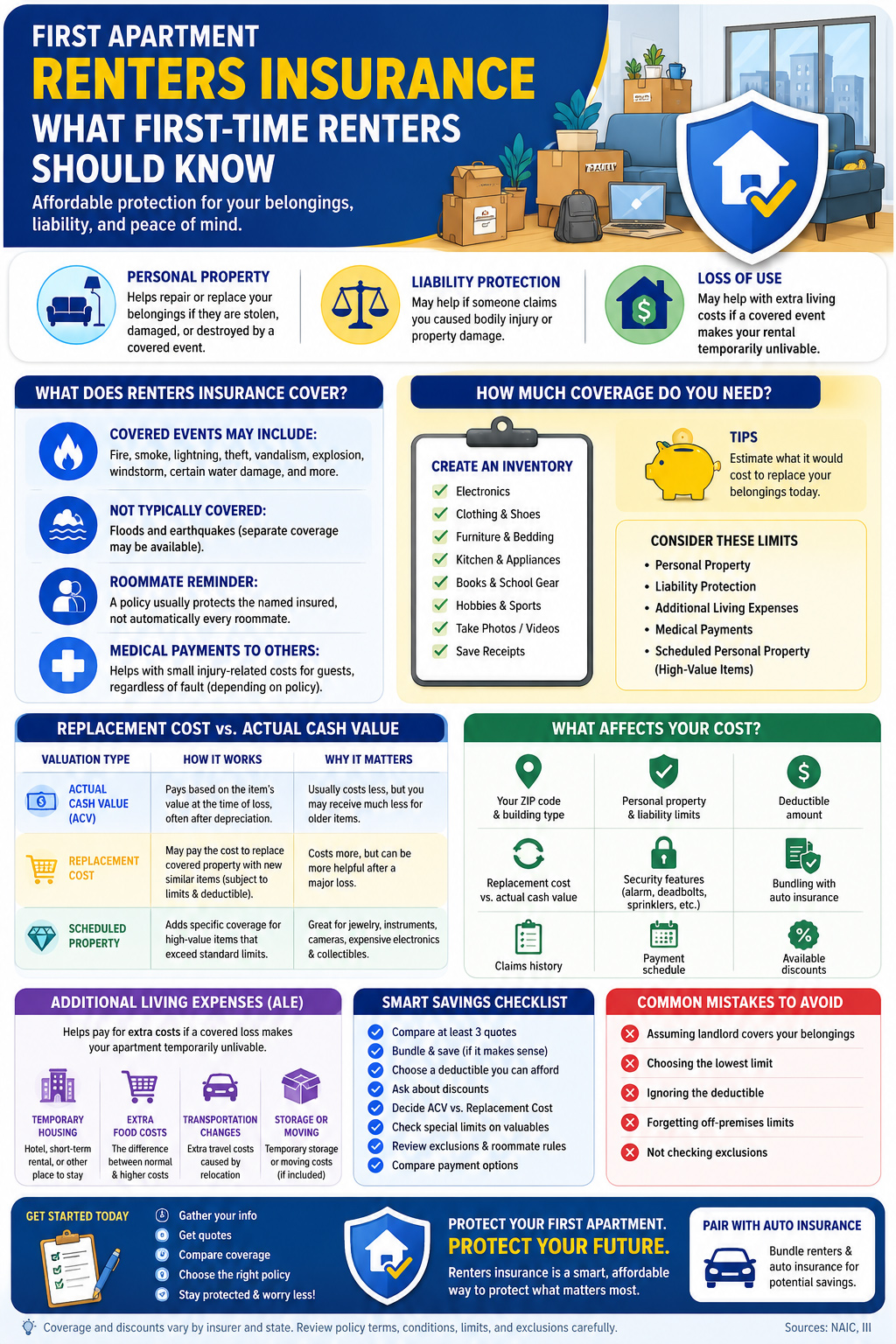
A landlord or property manager generally insures the building and the owner’s financial interest in it, not the tenant’s personal belongings. Renters insurance can provide protection for personal property, personal liability, and additional living expenses after eligible covered losses.
For a young adult renting a first apartment, living with roommates, or moving off campus, the important policy differences usually involve personal-property limits, deductibles, actual cash value versus replacement cost, liability limits, exclusions, and how the policy treats belongings away from the rental.
What Renters Insurance Can Cover for a Young Renter
NAIC explains that renters insurance commonly includes three main areas: personal property, liability protection, and additional living expenses. A landlord’s or property-management company’s insurance does not cover the tenant’s personal items simply because those items are inside the rental. [1]
Renters coverage is separate from auto insurance and other policy types. Young adults handling several insurance decisions at the same time may find insurance basics for young adults useful for keeping those different types of protection separate.
Personal property
Can help repair or replace eligible belongings damaged, destroyed, or stolen by a covered cause of loss, subject to limits and the deductible.
Personal liability
Can respond to certain claims involving bodily injury or property damage for which an insured is legally responsible, subject to policy terms and exclusions.
Additional living expenses
Can help with eligible additional costs when a covered loss makes the rental uninhabitable and temporary living arrangements are necessary.
Covered Events Depend on the Renters Policy
The policy form determines which causes of loss are covered. Triple-I lists fire or smoke, lightning, vandalism, theft, explosion, windstorm, and certain types of water damage among common examples in renters coverage. [2]
Flood and earthquake losses are commonly excluded from standard renters policies and may require separate insurance or an available endorsement. The exact exclusions and options depend on the insurer and location. [2]
| Policy Area | What to Check |
|---|---|
| Fire and smoke | Whether the cause of loss is covered and how the deductible applies. |
| Theft and vandalism | Personal-property limits, special limits, documentation, and off-premises provisions. |
| Water damage | Which types of accidental water loss are covered and which are excluded. |
| Flood | Whether separate flood coverage is needed for personal property. |
| Earthquake | Whether earthquake coverage or an endorsement is available. |
Renters Insurance Exclusions and Limits to Check
A policy can contain both exclusions and coverage limits. These are not the same thing. An exclusion can remove coverage for a particular type of loss, while a special limit can restrict how much the policy pays for certain property even when the loss itself is covered.
| Issue | What It Can Mean | What to Check |
|---|---|---|
| Flood | Standard renters coverage commonly excludes flood. | Separate flood coverage or another available option. |
| Earthquake | Standard coverage commonly excludes earthquake damage. | Separate earthquake coverage or an applicable endorsement. |
| High-value property | Certain categories of property may be subject to special limits. | The declarations, special limits, and any scheduled-property or floater options. |
| Roommate belongings | A roommate is not automatically insured merely because that person lives in the same unit. | Who qualifies as an insured and whether joint coverage is permitted. |
| Business property | Property used for business activity can be subject to different limits or exclusions. | Home-business provisions, property limits, and liability exclusions. |
How to Estimate a Personal Property Limit
A personal-property limit should be evaluated against the amount it could cost to replace the belongings the renter wants insured. Triple-I recommends creating a home inventory as a practical way to estimate the value of personal possessions. [2]
First-apartment inventory
- Electronics such as a laptop, phone, tablet, monitor, gaming system, headphones, and camera equipment.
- Clothing, shoes, coats, bags, bedding, towels, and personal items.
- Furniture, mattress, kitchen equipment, and small appliances.
- Bikes, sports equipment, musical instruments, tools, and hobby equipment.
- Items used for school or work.
- Higher-value property that may be subject to special policy limits.
Photos, receipts, serial numbers, purchase records, and appraisals can also help document ownership or value when they are available. The insurer’s claim requirements determine what documentation is ultimately needed.
Actual Cash Value vs. Replacement Cost
Actual cash value and replacement cost are methods for determining how insured property losses are valued. They should not be confused with scheduled-property coverage.
NAIC explains that actual cash value accounts for age, wear, and depreciation. Replacement cost coverage is based on repairing or replacing eligible damaged property with property of like kind and quality, subject to the contract and policy limits. [3]
| Valuation Method | General Approach | What to Verify |
|---|---|---|
| Actual cash value | Values covered property after accounting for depreciation. | How depreciation is calculated and how the deductible applies. |
| Replacement cost | Uses the cost of replacing eligible property with similar new property, subject to policy provisions. | Whether replacement must occur before the full replacement-cost amount becomes payable and what deadlines apply. |
Some replacement-cost policies can initially pay an amount based on actual cash value and make additional replacement-cost amounts available after eligible property is replaced and the policy requirements are met. Check the specific settlement provisions in the contract.
How Additional Living Expenses Can Work
Additional Living Expenses, often called ALE, can apply when a covered loss makes the rental uninhabitable and the insured incurs additional costs while living somewhere else.
NAIC explains that ALE is intended for expenses above the household’s normal living costs rather than every expense incurred during the displacement. [4]
| Possible Expense | What to Check |
|---|---|
| Temporary housing | Policy dollar limits, time limits, receipts, and any insurer requirements. |
| Additional food costs | Whether the policy covers the increase above normal food expenses. |
| Additional transportation | Whether relocation creates eligible transportation expenses under the policy. |
| Temporary storage or moving costs | Whether those expenses qualify under the policy and claim. |
Dorm Housing and Off-Campus Apartments
College housing can change which policy may respond to a student’s belongings. NAIC notes that a student living in on-campus housing may have some protection under a parent’s homeowners or renters policy, although limits and exclusions can apply. [1]
Off-campus living can require a different arrangement. The student’s actual policy and household status should be checked rather than assuming that coverage from a parent’s home automatically follows to a separate apartment.
On-campus housing
Check whether a parent’s policy extends personal-property coverage, what limits apply away from home, and whether the student still meets the policy’s definition of an insured.
Off-campus rental
Check whether a separate renters policy is needed for the apartment and the student’s belongings and liability exposure.
Lease requirements
Some landlords or property companies require tenants to carry renters insurance, so the lease should be checked for required liability limits or other conditions.
Renters Insurance With Roommates
Living together does not automatically make every roommate an insured under the same policy. Triple-I notes that joint coverage rules can vary by state and insurance company. [2]
Roommate details to verify
- Who is listed or defined as an insured.
- Whose personal property is covered.
- Whether unrelated roommates can share one policy.
- How personal-property limits apply if more than one person is insured.
- How liability coverage applies between roommates.
- What happens to the policy if one roommate moves out before the other.
Belongings Away From the Apartment
Personal-property coverage can extend beyond the rental itself. Triple-I notes that renters policies commonly include off-premises protection for covered belongings away from home. [2]
This can be important for young renters who regularly carry laptops, phones, bikes, cameras, school equipment, or other personal items outside the apartment. Limits, deductibles, covered causes of loss, and special property restrictions still apply.
Check the policy for any separate limits, territorial provisions, exclusions, or special conditions that apply when property is away from the insured residence.
Pets, Remote Work, and Side-Business Property
A first apartment may also contain pet-related liability exposures, employer equipment, or property used for a side business. These situations should be checked separately instead of assuming every item or activity receives the same renters coverage.
| Situation | What to Check |
|---|---|
| Pet | How liability coverage applies to the animal and whether the insurer has eligibility or coverage restrictions. |
| Employer-owned laptop or equipment | Whether the property is insured by the employer, the renters policy, or another arrangement. |
| Side-business equipment | Business-property limits and whether an endorsement or separate business policy is needed. |
| Business inventory | Whether inventory is covered at all and what limits or exclusions apply. |
NAIC warns that homeowners and renters policies can have important limitations for business-related property and liability, especially when the insured operates a business from home. [5]
What Can Affect the Cost of Renters Insurance?
Renters insurance pricing varies by insurer and applicant. Coverage limits, deductible, valuation method, location, property characteristics, claims information, optional coverage, and applicable discounts can all affect a quote.
| Policy Factor | What to Keep Consistent Between Quotes |
|---|---|
| Personal-property limit | Use the same or similar amount of personal-property coverage. |
| Liability limit | Check that the liability limits are equivalent. |
| Deductible | A different deductible changes the insured’s portion of an applicable property loss and can affect premium. |
| Valuation method | Check whether personal property is settled on an actual-cash-value or replacement-cost basis. |
| Optional property coverage | Keep scheduled items, riders, or endorsements consistent. |
| Discounts | Verify which discounts are included and what eligibility requirements apply. |
Renters Insurance Discounts and Multi-Policy Pricing
Discounts vary substantially by insurer and state. NAIC notes that some companies offer renters discounts for qualifying safety or security features and for having more than one policy with the same company. [1]
A renters-and-auto bundle should be evaluated using the combined premiums and the actual terms of both policies rather than assuming bundling is automatically less expensive. For a renter who also needs lower-cost auto insurance for young drivers , the auto policy remains a separate coverage decision even when both policies come from the same company.
Discount questions to ask
- Is a multi-policy discount available?
- Which safety or security devices qualify?
- Does the discount apply to renters, auto, or both policies?
- What documentation is required?
- Does the discount continue at renewal?
- What is the combined policy cost after all applicable discounts?
Renters Policy Details That Can Change a Claim Payment
Two renters policies with similar premiums can still produce different results after a loss. The difference can come from the personal-property limit, valuation method, deductible, special limits, covered causes of loss, ALE provisions, or exclusions.
The maximum available coverage can differ even when two policies look similar at first.
Depreciation and replacement requirements can materially change the amount payable for eligible property.
An applicable deductible reduces the amount recoverable under a covered property claim according to the policy.
Certain categories of property may have limits below the overall personal-property amount.
Property away from the rental may have different limits or conditions.
Dollar and time limits can affect reimbursement during a temporary displacement.
Information to Prepare for a Renters Insurance Quote
Accurate information makes it easier to see whether two quotes are actually offering similar coverage.
Quote information checklist
- Rental address and unit type.
- Move-in or requested policy effective date.
- Estimated value of personal belongings.
- Personal-property limit being considered.
- Liability limit being considered.
- Deductible options.
- ACV or replacement-cost treatment.
- Security or safety features requested by the insurer.
- Roommate information when relevant.
- Pet information when requested.
- Business or work-related property when applicable.
- Higher-value items that may need additional coverage.
Details to Check Before the Renters Policy Starts
- The named insured and rental address are correct.
- The policy effective date matches any lease requirement.
- Personal-property and liability limits match the selected quote.
- The deductible is shown correctly.
- ACV or replacement-cost treatment is clear.
- Flood, earthquake, and other applicable exclusions are understood.
- Special limits for higher-value property are identified.
- Roommate and off-premises coverage provisions are clear.
- ALE limits and conditions are identified.
- Any landlord certificate or proof requirement can be satisfied.
Frequently Asked Questions
Does my landlord’s insurance cover my belongings?
Landlord or property-management insurance generally does not insure the tenant’s personal belongings. Renters insurance is designed to address the tenant’s eligible personal-property losses according to the policy.
What does renters insurance generally include?
Renters policies commonly include personal-property coverage, personal liability, and additional living expenses. Other coverage and policy features depend on the insurer and contract.
Can a landlord require renters insurance?
Some landlords or property companies require renters insurance as a condition of the rental agreement. Check the lease for any required liability limit, proof-of-insurance provision, or other condition.
How does replacement cost differ from actual cash value?
Actual cash value generally reflects depreciation when covered property is valued. Replacement-cost coverage uses the cost of replacing eligible property with similar property, subject to policy terms, limits, and claim-settlement requirements.
Does renters insurance automatically cover a roommate?
No. Simply sharing an apartment does not automatically make an unrelated roommate an insured under the same policy. Joint-policy and named-insured rules vary by insurer and state.
Can a college student’s belongings be covered in a dorm?
They may be covered under a parent’s homeowners or renters policy depending on the student’s household status and the policy terms. Off-premises limits and exclusions can apply.
Does renters insurance cover a laptop away from home?
Many renters policies provide some off-premises personal-property coverage, but applicable limits, deductibles, exclusions, and covered causes of loss still apply.
Does standard renters insurance cover floods and earthquakes?
Standard renters policies commonly exclude flood and earthquake losses. Separate coverage or endorsements may be available depending on the location and insurer.
What should a young renter check before choosing a policy?
Check personal-property and liability limits, deductible, valuation method, covered causes of loss, exclusions, off-premises provisions, additional living expense limits, roommate rules, and special limits for valuable property.
Final Thoughts on Renters Insurance for Young Adults
A renters insurance quote is easier to evaluate when the personal-property limit, liability limit, deductible, valuation method, and optional coverage are consistent. A lower-priced policy may simply contain different limits or claim-settlement provisions.
For young adults, the details most likely to deserve extra attention are first-apartment lease requirements, roommates, dorm or off-campus living, laptops and other belongings away from home, additional living expenses, and any property used for work or a side business.
This article provides general educational information about renters insurance. Coverage, deductibles, personal-property limits, valuation methods, exclusions, additional living expenses, roommate eligibility, discounts, lease requirements, and off-premises coverage vary by insurer, state, property, and policy. The actual insurance contract controls coverage.
References
- [1] National Association of Insurance Commissioners, “Do I Need Renters Insurance for College?” NAIC ↩ ↩ ↩
- [2] Insurance Information Institute, “Your Renters Insurance Guide.” Triple-I ↩ ↩ ↩ ↩ ↩
- [3] National Association of Insurance Commissioners, “What’s the Difference Between Actual Cash Value Coverage and Replacement Cost Coverage?” NAIC ↩
- [4] National Association of Insurance Commissioners, “What Are Additional Living Expenses and How Can Insurance Help?” NAIC ↩
- [5] National Association of Insurance Commissioners, “Working From Home & Your Insurance Coverage.” NAIC ↩