
By YoungAmericansInsurance.com Editorial Team
Created on
· Updated on
Editorial note
The YoungAmericansInsurance.com Editorial Team creates plain-language insurance content for drivers and young adults comparing coverage, pricing, and policy options.
This article provides general educational information. Coverage, discounts, eligibility, underwriting, and pricing vary by insurer, state, vehicle, driver profile, and policy terms.
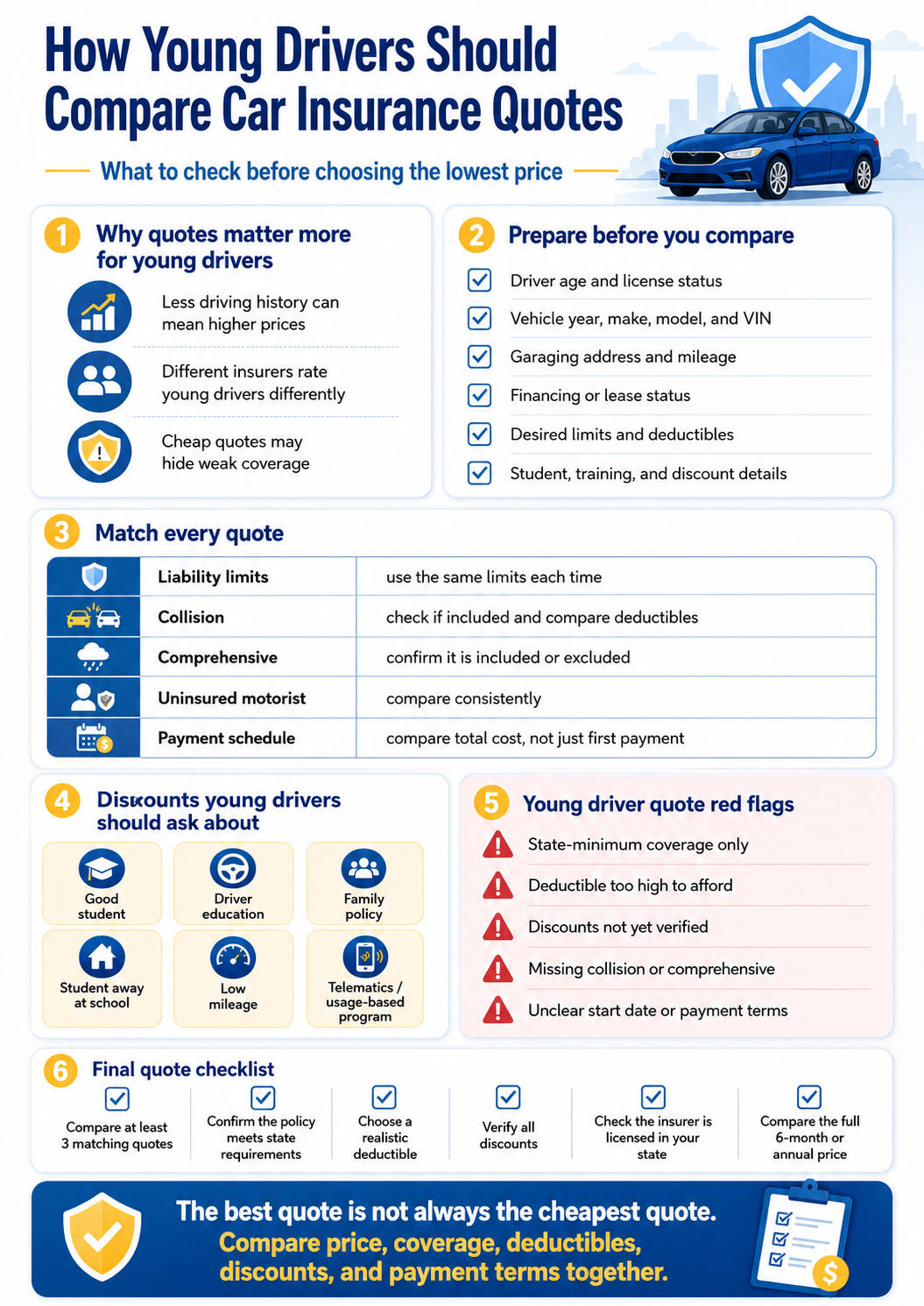
Young drivers should compare car insurance quotes carefully because a lower monthly price can result from lower liability limits, higher deductibles, fewer coverages, different payment terms, or discounts that have not yet been verified.
The most useful comparison keeps the driver information, vehicle, coverage limits, deductibles, and optional protections consistent so that price differences are easier to evaluate.
Why Quote Comparison Matters for Young Drivers
Auto insurance pricing can vary significantly among insurers because each company uses its own underwriting and rating approach within applicable state rules. Age, driving experience, vehicle, location, driving record, coverage choices, and available discounts can all influence the quote.
Evidence about teenage drivers should not automatically be applied to every young adult. Triple-I identifies teen drivers as a higher-risk group because they have limited driving experience, while NHTSA reports that novice teen drivers have a higher fatal-crash risk than adult drivers. [1] [2]
A newly licensed adult may have limited driving history without having the same age-related risk profile as a teenage driver. This is one reason quotes should be compared using the driver’s actual information rather than assumptions based only on age.
Driving experience
A newer driver has less driving history for an insurer to evaluate, regardless of whether that driver is a teenager or an adult.
Insurer pricing varies
Different insurers can price the same driver and vehicle differently, making multiple comparable quotes useful.
Coverage affects price
Lower limits, larger deductibles, or omitted coverage can make one quote appear cheaper than another.
Prepare the Same Information for Every Quote
Quote comparisons become less useful when the driver list, vehicle details, garaging address, mileage, or coverage selections change from one insurer to another.
Keeping liability limits, deductibles, and other basic policy terms consistent makes it easier to compare price without accidentally comparing different levels of protection.
Quote preparation checklist
- Driver name, age, license status, and driving history.
- Vehicle year, make, model, trim, VIN, and ownership status.
- Garaging address and expected annual mileage.
- Whether the vehicle is financed, leased, or owned outright.
- Current insurance and any prior coverage gaps.
- Liability limits and physical-damage coverage.
- Collision and comprehensive deductibles.
- UM/UIM, MedPay, PIP, rental, roadside, or other selected options.
- Student or driver-training information when applicable.
A quote based on incomplete or inaccurate information can change during underwriting. Use the same information whenever possible across every company you compare.
Make Every Quote Use Comparable Coverage
The NAIC recommends obtaining multiple quotes and comparing equivalent coverage, limits, deductibles, and policy details rather than judging a policy from price alone. [3]
| Quote Detail | What to Match | Why It Matters |
|---|---|---|
| Liability limits | Use the same bodily injury and property damage limits. | A state-minimum quote can look cheaper than one with higher liability protection. |
| Collision coverage | Include or exclude it consistently and use the same deductible. | Removing collision can significantly change both price and vehicle protection. |
| Comprehensive coverage | Use the same inclusion and deductible. | Theft, vandalism, hail, fire, animal damage, and other qualifying losses may otherwise be treated differently. |
| UM/UIM | Keep the same limits and selection where available. | Removing or reducing this coverage can make a quote cheaper while also reducing protection. |
| Payment schedule | Compare the complete premium and any installment charges. | A lower first or monthly payment does not necessarily mean a lower total policy cost. |
Choose a Deductible the Driver Can Afford
A deductible is the amount that applies before the insurer pays its portion of certain covered collision or comprehensive losses. A higher deductible can reduce the premium, but it also increases the amount the driver must absorb after a qualifying claim.
| Deductible Choice | Possible Benefit | Trade-Off |
|---|---|---|
| Lower deductible | Less out of pocket after a qualifying claim. | The premium may be higher. |
| Higher deductible | The premium may be lower. | More cash is required after a qualifying loss. |
| No collision or comprehensive | The premium may fall considerably. | The insured vehicle may no longer have protection against many types of physical damage. |
A deductible should remain manageable after an unexpected loss. A lower premium is less useful if the policy becomes difficult to use when a claim occurs.
Ask About Discounts That Actually Apply
Discount availability varies by insurer and state. Triple-I notes that teen drivers may qualify for good-student or driver-training discounts, and some insurers offer reduced pricing when a student attends school away from home. [1]
Discounts worth asking about
- Good-student discount.
- Driver-training or approved driver-education discount.
- Student-away-at-school discount.
- Multi-vehicle pricing.
- Household or multi-policy discounts where available.
- Usage-based or telematics programs.
- Other insurer-specific discounts for which the driver qualifies.
Discount estimates should not be treated as final until the insurer confirms eligibility and any required documentation.
Family Policy vs. Separate Policy
For a teenage driver living with parents or guardians, adding the driver to an existing household policy can sometimes cost less than purchasing a separate policy. The actual result depends on insurer rules, vehicles, household drivers, coverage, location, and discount eligibility. [1]
| Situation | Possible Advantage | What to Confirm |
|---|---|---|
| Added to household policy | May allow the young driver to share existing household coverage and eligible discounts. | Which vehicle the driver is assigned to and how much the total household premium changes. |
| Separate policy | Provides separate billing and policy structure. | Whether the separate premium and coverage are affordable and appropriate. |
| Student away at school | Some insurers may offer a discount when eligibility conditions are met. | Distance, vehicle availability, residence, and insurer requirements. |
| Young adult with own vehicle | May need a different policy structure based on ownership and household circumstances. | Vehicle ownership, residence, regular drivers, coverage limits, and payment responsibilities. |
Answer insurer questions about household and regular drivers completely. Omitting someone who regularly uses a vehicle can affect underwriting, premiums, claims handling, cancellation, or renewal.
Vehicle Choice Can Change the Quote
A young driver’s premium can change materially depending on the vehicle. Value, repair cost, theft exposure, safety characteristics, engine performance, and available replacement parts can all affect pricing.
For teenage drivers, vehicle characteristics that can affect insurance costs for teens are worth considering before a first car is purchased rather than after the insurance quote has already been requested.
Understand How Telematics Can Affect the Quote
Usage-based insurance programs may use a smartphone, vehicle system, or plug-in device to measure driving activity. NAIC explains that programs can consider information such as mileage, time of day, acceleration, braking, cornering, speed, and in some cases phone-related behavior. [4]
Before enrolling, ask:
- What information is collected?
- How long is the monitoring period?
- Can the program increase as well as decrease the premium?
- Does the program consider phone use or location?
- Who can access the driving data?
- Can participation be ended later?
- How does participation affect renewal pricing?
Depending on the insurer, driving behavior, state rules, and program design, usage-based insurance can affect premiums in different ways.
Young Driver Quote Red Flags
A low quote deserves closer inspection when important coverage, underwriting, or company information is unclear.
The quote may satisfy a legal requirement while providing less liability protection than another option.
A high deductible can reduce premium but create a difficult out-of-pocket expense after a covered claim.
The price can change if student, training, telematics, or other discounts are not ultimately approved.
Liability coverage does not normally repair the insured vehicle after an at-fault collision.
A quote is not active insurance. Confirm when the policy becomes effective.
Check state licensing and available complaint information before relying on an unfamiliar insurer or agency.
Evaluate the Insurance Company as Well as the Quote
Price is only one part of the decision. NAIC recommends checking whether the insurance company or agent is authorized in the applicable state and comparing policy details before purchasing coverage. [3]
| Company Factor | What to Check |
|---|---|
| Licensing | Verify the insurer or agency through the applicable state insurance department. |
| Complaint information | Use state or regulatory consumer information where available rather than relying only on isolated online reviews. |
| Policy clarity | The declarations page should clearly identify drivers, vehicles, limits, deductibles, dates, and coverage. |
| Claims process | Confirm how a claim is reported and which company or administrator handles it. |
| Payment terms | Understand the complete premium, installment schedule, fees, and cancellation provisions. |
Before You Buy: Final Quote Checklist
Confirm before paying
- The correct drivers and vehicles are included.
- The garaging address and mileage are accurate.
- The policy satisfies applicable state requirements.
- Liability limits match across the quotes being compared.
- Collision and comprehensive selections are equivalent.
- Deductibles are affordable and consistent.
- UM/UIM and other optional protections are compared consistently.
- Discounts are verified or clearly identified as pending.
- The insurer or agency is authorized in the state.
- The effective date and proof-of-insurance process are clear.
- The complete policy-term premium is understood.
Frequently Asked Questions
How many car insurance quotes should a young driver compare?
NAIC’s auto-insurance shopping guidance recommends obtaining at least three quotes. The quotes are most useful when the same drivers, vehicles, limits, deductibles, and optional coverages are used. [3]
Why do young driver quotes vary?
Insurers can use different rating methods and underwriting rules. Driving experience, age, vehicle, location, driving history, coverage, and discount eligibility can all influence price.
Is the cheapest quote always the best option?
No. A lower price may result from lower liability limits, higher deductibles, fewer protections, or different payment terms.
Should a teen driver stay on a family policy?
Adding a teen to an existing household policy can sometimes cost less than buying a separate policy, but the actual result depends on insurer rules, household vehicles, coverage, location, and discounts.
Can telematics lower a young driver’s premium?
It can for some drivers, but the result depends on driving behavior, insurer rules, program design, and state requirements. Some programs can affect rates in either direction.
What should young drivers avoid when comparing quotes?
Avoid comparing policies with different limits or deductibles, omitting regular drivers, relying on unverified discounts, choosing an unaffordable deductible, or assuming a quote means coverage is active.
Final Thoughts on Comparing Young Driver Car Insurance Quotes
Young drivers should compare equivalent policies before comparing price. Liability limits, physical-damage coverage, deductibles, optional protections, discounts, company information, payment terms, and the complete premium all affect the value of a quote.
A useful quote is not simply the lowest number displayed. It is a quote based on accurate information and coverage that the driver understands and can realistically maintain.
References
- [1] Insurance Information Institute (Triple-I), “Auto Insurance for Teen Drivers.” Source ↩
- [2] National Highway Traffic Safety Administration, “Teen Driving.” Source ↩
- [3] National Association of Insurance Commissioners, “A Shopping Tool for Auto Insurance.” Source ↩
- [4] National Association of Insurance Commissioners, “Understanding Usage-Based Insurance.” Source ↩