
By YoungAmericansInsurance.com Editorial Team
Published on
Updated on
Editorial details
This article was reviewed for FMCSA financial-responsibility requirements, federal filing forms, commercial truck coverage terminology, cargo distinctions, owner-operator exposures, underwriting information, and source accuracy.
YoungAmericansInsurance.com publishes general educational information. Commercial insurance requirements, filings, limits, exclusions, underwriting, contracts, and state obligations vary by operation and jurisdiction.
Commercial truck insurance can involve several different coverages and financial-responsibility requirements. The insurance structure for an interstate for-hire carrier can differ substantially from the structure used by an intrastate business, leased owner-operator, household-goods mover, private carrier, or fleet.
Vehicle type and weight, operating authority, cargo, radius, drivers, ownership, lease agreements, contracts, state rules, and federal financial-responsibility requirements can all affect what must be documented or insured.
What Is Commercial Truck Insurance?
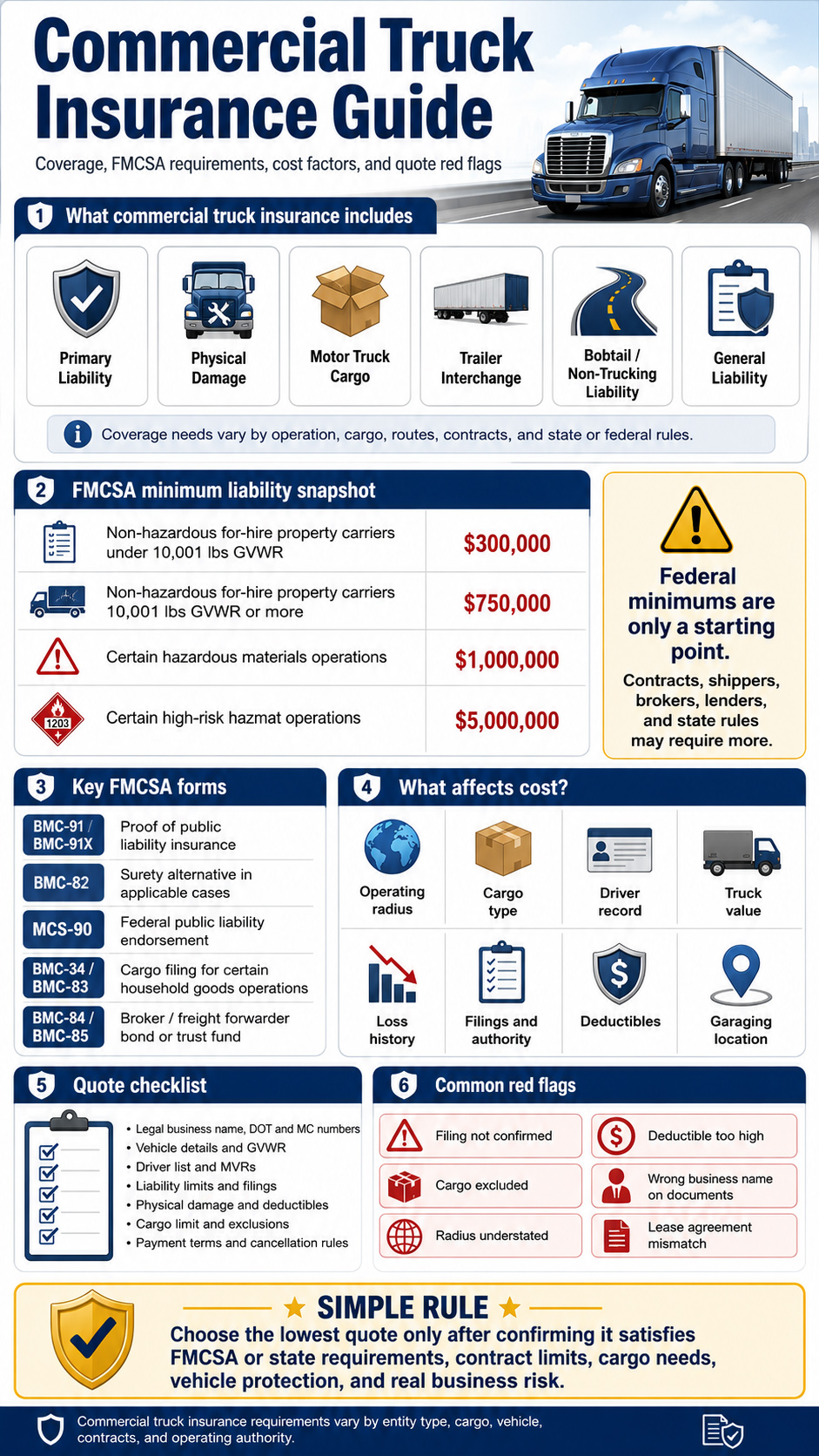
Commercial truck insurance is not one standardized coverage. A trucking insurance program can combine commercial auto liability, physical damage, motor truck cargo, trailer-related coverage, non-trucking liability, and other business coverages depending on the operation.
Federal filings are a separate issue. FMCSA states that its financial responsibility requirements vary according to entity type, operating authority, cargo, and vehicle type. FMCSA will not grant applicable operating authority until the required minimum financial responsibility is in effect and on file with the agency. [1]
Insurance coverage
Defines which eligible liability, vehicle, cargo, or business losses the policy addresses.
Financial responsibility
Federal or state rules can require specified minimum limits or other evidence of financial responsibility.
Filings and endorsements
Certain operations require filings with FMCSA, while other forms are endorsements or surety mechanisms rather than ordinary insurance coverages.
FMCSA Financial Responsibility for Motor Carriers of Property
FMCSA’s current insurance filing chart lists different bodily injury and property damage financial-responsibility amounts for different property carrier operations. [1]
| Carrier Operation | FMCSA BIPD Amount | Federal Filing Note |
|---|---|---|
| For-hire property carrier, non-hazardous, GVWR under 10,001 pounds | $300,000 | FMCSA lists BMC-91, BMC-91X, or BMC-82 as applicable forms. |
| For-hire property carrier, non-hazardous, GVWR 10,001 pounds or more | $750,000 | FMCSA lists BMC-91, BMC-91X, or BMC-82. |
| For-hire carrier of certain hazardous materials | $1,000,000 | The commodity and operation determine which federal requirement applies. |
| For-hire or private carrier of explosives, poison gas, radioactive materials, or specified high-risk hazardous materials | $5,000,000 | Applicable federal hazardous-material rules determine the financial-responsibility requirement. |
| For-hire household-goods carrier, GVWR 10,001 pounds or more | $750,000 BIPD | FMCSA’s chart also lists a separate $5,000 cargo filing requirement using BMC-34 or BMC-83. |
State requirements, shipper or broker contracts, lease agreements, lender requirements, cargo arrangements, and business risk-transfer decisions can call for different or additional coverage. The FMCSA minimum should not be treated as a universal recommended policy limit.
BMC Filings, MCS-90, and MCS-82 Are Different
FMCSA uses several forms to document financial responsibility. They are not all the same type of document, and none should be treated simply as a synonym for commercial truck insurance. [1]
| Form | General Function | Important Distinction |
|---|---|---|
| BMC-91 / BMC-91X | Evidence of insurance used for applicable motor-carrier public liability financial-responsibility filings. | Filed electronically by an authorized financial-responsibility filer rather than functioning as a separate first-party coverage. |
| BMC-82 | Surety-bond mechanism for applicable motor-carrier public liability financial responsibility. | It is a bond alternative, not an ordinary physical-damage or cargo policy. |
| MCS-90 | Federal public-liability endorsement attached to an applicable motor carrier’s insurance policy. | It is not an insurance filing equivalent to BMC-91 and should not be treated as ordinary first-party vehicle or cargo coverage. |
| MCS-82 | Motor-carrier public-liability surety-bond form. | It serves the federal surety mechanism rather than functioning as a commercial auto policy endorsement. |
| BMC-34 / BMC-83 | Cargo insurance or cargo surety filing forms for applicable household-goods operations. | They do not create a universal federal cargo filing requirement for every general freight carrier. |
What the MCS-90 Does
FMCSA describes the MCS-90 as an endorsement required under federal financial-responsibility rules. It is attached to the motor carrier’s liability insurance policy rather than issued for individual vehicles. It applies to vehicles operated under that policy that are subject to the federal financial-responsibility requirements. [2]
The endorsement is intended to support federally required public liability financial responsibility. It should not be interpreted as ordinary collision, physical-damage, cargo, or other first-party insurance.
The underlying commercial auto policy contains its own coverage terms, conditions, limits, and exclusions. The MCS-90 addresses a specific federal financial-responsibility function.
Business Name and Address Matching for FMCSA Filings
FMCSA cautions applicants to make sure the business name and address in pre-registration records match the name and address used in the operating authority application. FMCSA states that deviations can delay the granting of authority. [1]
Information to keep consistent
- Legal business name.
- Applicable DBA information.
- Business address.
- USDOT number.
- MC or other operating-authority identifier when applicable.
- Entity information supplied to the financial-responsibility filer.
Commercial Truck Coverage Areas
Federal financial responsibility addresses only part of a trucking business’s insurance picture. Separate coverages can address the truck, cargo, trailers, non-auto business liability, or particular owner-operator exposures.
| Coverage | What It Can Address | What to Verify |
|---|---|---|
| Commercial auto liability | Eligible bodily injury and property damage liability arising from covered vehicle operations. | Limits, covered autos, operation, territory, exclusions, and any required financial-responsibility filings. |
| Physical damage | Covered damage to owned or otherwise insured tractors, trucks, or trailers. | Collision and other covered causes of loss, valuation, deductibles, equipment, and lender or lease requirements. |
| Motor truck cargo | Certain covered loss or damage to cargo for which the carrier has responsibility. | Commodities, exclusions, limits, valuation, theft conditions, refrigeration provisions, and deductibles. |
| Trailer interchange | Covered physical damage to qualifying non-owned trailers used under an applicable trailer interchange agreement. | Written agreement requirements, trailer values, causes of loss, limits, and deductibles. |
| Non-trucking liability | Certain liability exposures during qualifying non-business use of a covered tractor. | Definition of business use, lease provisions, exclusions, and interaction with the motor carrier’s policy. |
| Commercial general liability | Certain non-auto business liability exposures. | Premises, operations, exclusions, contractual requirements, and whether the exposure is actually auto-related. |
Commercial Auto Liability and Federal Financial Responsibility
Commercial auto liability can provide the underlying insurance used to satisfy applicable public-liability obligations, but the business should distinguish the policy limit from any separate FMCSA filing requirement.
Liability information to verify
- Whether the operation is interstate, intrastate, or both.
- Which federal and state financial-responsibility rules apply.
- The legal entity covered by the policy.
- Covered vehicles and applicable symbols or scheduling provisions.
- Required BMC filing or surety mechanism, if applicable.
- Whether an MCS-90 or MCS-82 applies.
- Liability limits required by contracts or lease agreements.
Physical Damage Coverage for Commercial Trucks
Physical damage generally concerns covered loss to the insured equipment itself rather than liability owed to another party. Commercial truck policies can separate collision from other covered physical-damage causes, and some products use specified-perils forms instead.
| Physical Damage Area | General Function | Policy Terms to Check |
|---|---|---|
| Collision | Can address eligible physical damage resulting from collision or overturn. | Valuation, deductible, covered equipment, exclusions, and repair provisions. |
| Comprehensive-type coverage | Can address certain covered losses other than collision, depending on the commercial policy form. | Theft, fire, weather, vandalism, glass, animal losses, exclusions, and deductible provisions. |
| Specified perils | Covers only the causes of loss specifically identified by the policy. | The precise list of covered causes and what is omitted. |
| Downtime-related coverage | Some products or endorsements can address certain lost-use or substitute-equipment expenses after an eligible loss. | Trigger, waiting provisions if any, dollar limits, duration, and exclusions. |
Financing or leasing can also create contractual physical-damage requirements. The finance or lease agreement should be checked separately from federal public-liability requirements.
Motor Truck Cargo Insurance
Motor truck cargo coverage is separate from commercial auto liability and physical damage. Its policy wording determines which commodities, causes of loss, locations, handling activities, and valuation methods are covered.
FMCSA’s filing chart lists BMC-34 or BMC-83 cargo filings for certain household-goods carrier and freight-forwarder operations. The chart does not establish a universal federal cargo-insurance filing requirement for every general freight motor carrier. [1]
It should not be interpreted as a generally appropriate motor-truck cargo policy limit for all loads or contracts. Cargo limits and insurance requirements can be determined separately by policy terms, contracts, commodities, and the business operation.
Cargo policy questions
- Which commodities are covered?
- Which commodities are excluded or subject to special limits?
- How does the policy value cargo after an eligible loss?
- What theft conditions or security requirements apply?
- Are refrigeration or temperature-change losses covered, excluded, or available by endorsement?
- How are loading and unloading exposures treated?
- What deductible structure applies?
- What claim documentation is required?
Trailer Interchange and Non-Owned Trailers
Trailer interchange coverage can apply to physical damage involving a non-owned trailer in the carrier’s possession under a qualifying trailer interchange arrangement. Coverage depends on the policy and the agreement under which the trailer is being used.
Trailer information to verify
- Whether a written trailer interchange agreement is required.
- The maximum trailer value to be insured.
- The causes of loss covered by the form.
- The applicable deductible.
- Whether refrigerated, specialty, or permanently attached equipment is included.
- How coverage differs for other non-owned trailers not used under an interchange agreement.
Bobtail and Non-Trucking Liability Are Not Identical Terms
“Bobtail” describes operation of a tractor without an attached trailer, while non-trucking liability generally refers to qualifying non-business use under the particular policy form. Whether either coverage applies depends on the policy wording, lease arrangement, dispatch status, and actual use of the tractor.
| Situation | Coverage Question |
|---|---|
| Tractor operated without a trailer | Does the policy define or cover the particular bobtail operation? |
| Tractor used for a personal trip | Does the non-trucking liability form treat the use as qualifying non-business activity? |
| Owner-operator operating under a motor carrier lease | Which policy applies under the lease and the actual business use at the time of the event? |
| Driving between loads or after delivery | Do not infer coverage solely from dispatch status; check the policy’s business-use wording. |
An owner-operator should identify which party provides each coverage and how the lease defines responsibility when the tractor is hauling, traveling without a trailer, or being used outside the motor carrier’s business.
Workers’ Compensation and Occupational Accident Coverage
Driver injury exposures should be evaluated separately from commercial auto liability. Workers’ compensation and occupational accident coverage are not interchangeable labels.
Workers’ compensation obligations depend on employment relationships and applicable state law. Occupational accident products use different contractual structures and should not automatically be treated as a substitute for legally required workers’ compensation.
Employee, independent-contractor, owner-operator, and fleet arrangements can create different insurance and statutory obligations. Applicable state requirements should be checked for the actual workforce structure.
Broker and Freight Forwarder Financial Responsibility
Broker and freight-forwarder financial responsibility is separate from insurance on trucks. FMCSA lists a $75,000 BMC-84 surety bond or BMC-85 trust fund requirement for property brokers and applicable freight forwarders. [3]
Since January 16, 2026, updated federal requirements apply to BMC-85 trust providers and other broker/freight-forwarder financial-responsibility procedures. FMCSA states that qualifying BMC-85 trust assets must total $75,000 and meet the updated asset and trustee requirements. [3]
A business that operates motor vehicles and separately performs brokerage or freight-forwarding activity can have distinct registration and financial-responsibility obligations for those functions.
Information That Can Affect a Commercial Truck Insurance Quote
Commercial trucking underwriting varies by insurer. Quotes can reflect differences in the operation, drivers, vehicles, loss history, requested coverage, filings, cargo, and contractual requirements.
| Information | What to Provide Accurately |
|---|---|
| Operating territory and radius | Actual states, routes, radius, interstate or intrastate activity, and expected mileage. |
| Vehicle schedule | VIN, type, GVWR, ownership, value, garaging location, and attached equipment. |
| Drivers | Driver information, licenses, experience, and records requested by the insurer. |
| Cargo | Actual commodities, values, refrigeration exposure, hazmat activity, and contractual requirements. |
| Loss history | Loss runs and claim information requested for the underwriting period. |
| Operating authority and filings | USDOT/MC information and the financial-responsibility filings required for the actual operation. |
| Coverage and deductibles | Requested liability limits, physical damage, cargo, trailer coverage, and applicable deductibles. |
Commercial Truck Insurance Deductibles
A deductible can apply to physical damage, cargo, or other coverages depending on the policy. A higher deductible may change the premium, but it also increases the business’s share of an eligible covered loss.
Deductibles should therefore be evaluated alongside the applicable coverage limit, claim valuation method, expected loss exposure, and the business’s available financial resources rather than only as a method for changing the premium.
Commercial Truck Quote Evaluation Checklist
Two commercial truck quotes with different premiums may also use different underwriting assumptions, filings, limits, deductibles, exclusions, or endorsements. Those differences should be identified before treating the premiums as equivalent.
Keep these items consistent where possible
- Legal business name and entity information.
- USDOT and operating-authority information.
- Vehicles, values, GVWR, garaging locations, and operating radius.
- Driver information.
- Actual freight and cargo types.
- Commercial auto liability limits.
- Required FMCSA or state filings.
- Physical damage valuation and deductibles.
- Cargo limits, deductibles, and exclusions.
- Trailer interchange or non-owned trailer requirements.
- Non-trucking liability terms where relevant.
- Policy-term premium and applicable billing charges.
Commercial Truck Policy Terms That Need Verification
Confirm that the financial-responsibility provider can submit and maintain the filing required for the actual operating authority.
Radius, interstate activity, vehicle use, cargo, and authority should reflect the operation actually being insured.
Commodity exclusions, theft provisions, refrigeration exposure, valuation, limits, and deductibles can materially change cargo coverage.
Confirm how the policy values insured tractors, trailers, and permanently attached equipment after an eligible covered loss.
Lease terms and policy definitions should align with the tractor’s business and non-business use.
Identify each applicable deductible and which vehicle, cargo, or occurrence it applies to.
Information to Prepare Before Requesting Coverage
Complete and consistent information can reduce underwriting questions and help the financial-responsibility filer match the operation correctly. FMCSA also emphasizes maintaining accurate entity information for federal filings.
Business and underwriting records
- Legal business name, DBA, address, USDOT number, and MC number.
- Vehicle schedule with VINs, GVWR, values, ownership, and garaging locations.
- Driver information requested by the insurer.
- Prior loss runs when requested.
- Current policy information when applicable.
- Commodities and cargo values.
- Operating radius, states traveled, and interstate status.
- Shipper, broker, lender, lease, or motor-carrier contracts containing insurance requirements.
- Required FMCSA or state filings.
- Certificate and additional-insured requirements, if applicable.
Risk Information Insurers May Consider
Individual insurers use their own underwriting standards. Driver records, loss history, equipment, maintenance information, safety procedures, cargo, routes, technology, and operating history may be relevant to a particular commercial truck quote.
Safety programs, dash cameras, telematics, GPS devices, anti-theft equipment, or driver training should not be assumed to create an automatic discount. Their underwriting or pricing effect depends on the insurer and program.
Operational information that may be requested
- Driver hiring and screening procedures.
- Motor vehicle records.
- Loss runs and corrective-action documentation.
- Vehicle maintenance and inspection procedures.
- Safety policies and driver-training records.
- Telematics or camera systems where relevant.
- Cargo security practices.
- Garaging and terminal security.
Maintaining Required FMCSA Filings
FMCSA states that entities with operating authority must keep required insurance and process-agent filings current and on file to avoid revocation proceedings. [1]
A late premium payment does not by itself establish that operating authority has been revoked. The relevant issue is whether required financial-responsibility filings remain effective and whether FMCSA has begun or completed an applicable authority proceeding.
Frequently Asked Questions
What is the federal minimum liability requirement for a commercial truck?
It depends on the carrier’s operation, cargo, and vehicle. FMCSA currently lists $300,000 for certain non-hazardous for-hire property carriers under 10,001 pounds GVWR, $750,000 for qualifying non-hazardous for-hire property carriers at 10,001 pounds GVWR or more, and higher amounts for certain hazardous-material operations.
Is an MCS-90 the same as commercial truck liability insurance?
No. The MCS-90 is a federal public-liability endorsement attached to an applicable motor carrier’s liability policy. It serves a specific federal financial-responsibility function and is not a substitute for understanding the underlying policy’s coverage.
Does every commercial truck need a federal BMC filing?
No. FMCSA filing requirements depend on the entity and operating authority. Intrastate operations can also be subject to separate state financial-responsibility requirements.
Is motor truck cargo insurance federally required for every carrier?
No. FMCSA lists cargo filing requirements for specified household-goods operations, but it does not impose that same cargo filing on every general freight motor carrier. Contracts and insurance needs can create separate cargo requirements.
What is the difference between physical damage and cargo insurance?
Physical damage addresses eligible covered loss to insured trucks or trailers. Motor truck cargo insurance addresses eligible loss or damage to covered cargo. The coverage forms, limits, deductibles, and exclusions are separate.
Are bobtail coverage and non-trucking liability the same?
Not necessarily. Bobtail refers to operation of a tractor without a trailer, while non-trucking liability generally depends on whether the tractor is being used for qualifying non-business purposes. Policy and lease wording control.
Who handles FMCSA insurance filings?
FMCSA states that the applicable financial-responsibility provider, such as an authorized insurer or surety, files the required forms on behalf of the applicant or registered entity.
What information can affect a commercial truck quote?
Depending on the insurer, relevant information can include vehicles, drivers, operating radius, states traveled, cargo, loss history, garaging, coverage limits, deductibles, operating authority, required filings, and contractual insurance requirements.
Final Thoughts on Commercial Truck Insurance
Commercial truck insurance requires separating several different issues: the underlying liability policy, federal or state financial responsibility, BMC filings, the MCS-90 or surety mechanism when applicable, physical damage, cargo, trailer exposure, owner-operator use, and contractual requirements.
The useful quote is the one whose business information, operating authority, vehicles, drivers, cargo, limits, deductibles, endorsements, and required filings accurately reflect the operation being insured.
This article provides general educational information about commercial trucking insurance and federal financial responsibility. FMCSA requirements depend on entity type, operating authority, vehicle, cargo, and operation. State requirements, contracts, insurance policy forms, underwriting, exclusions, limits, and workforce obligations can add separate requirements. Current federal requirements should be confirmed with FMCSA and applicable state or insurance authorities.
References
- [1] Federal Motor Carrier Safety Administration, “Insurance Filing Requirements.” FMCSA ↩ ↩ ↩ ↩ ↩ ↩
- [2] Federal Motor Carrier Safety Administration, “Form MCS-90 — Endorsement for Motor Carrier Policies of Insurance for Public Liability.” FMCSA ↩
- [3] Federal Motor Carrier Safety Administration, “Broker and Freight Forwarder Financial Responsibility Rule.” FMCSA ↩ ↩