
What “Buy Now, Pay Later” Means in Auto Insurance
“Buy now, pay later car insurance” is a phrase used online for several different payment arrangements, but it does not identify one standardized type of auto insurance policy. An insurer’s own installment billing plan, premium financing through a lender, and a true BNPL credit product are different arrangements.
The distinction matters because the party receiving payment, fees, credit terms, missed-payment consequences, and cancellation procedures can differ. The insurance coverage itself is still determined by the policy’s limits, deductibles, exclusions, effective dates, and other terms.

Quick Summary
- Monthly insurance billing is not automatically a BNPL loan.
- An insurer installment plan divides the insurance premium into scheduled payments.
- Premium financing involves a separate lender paying the premium and the policyholder repaying that lender, generally with interest or fees.
- A true BNPL product is a form of credit and should be evaluated under the lender’s own repayment terms.
- A quote is not active insurance. Confirm that the policy has been bound and that its effective date and time have begun.
- Compare the complete policy cost and the complete financing or billing cost rather than only the amount due initially.
Is Buy Now Pay Later Car Insurance a Separate Insurance Product?
No standardized auto coverage is created simply by labeling a payment arrangement “buy now, pay later.” Liability, collision, comprehensive, uninsured motorist coverage, and other insurance protections work according to the insurance policy regardless of how the premium is paid.
The Consumer Financial Protection Bureau describes BNPL as a type of installment loan that allows a consumer to obtain a product or service and repay the balance over a small number of installments. [1]
That definition is important because paying an insurance company monthly is not automatically borrowing through a BNPL lender. The financial arrangement must be identified separately from the insurance policy.
Insurance policy
Determines the actual coverage, limits, deductibles, exclusions, and effective period.
Billing arrangement
Determines when and how the premium is collected.
Credit agreement
Exists only when a separate lender or credit product is involved.
Insurer Installments vs. Premium Financing vs. BNPL Credit
These arrangements may all spread payments over time, but they should not be treated as interchangeable.
| Arrangement | How It Works | What to Confirm |
|---|---|---|
| Insurer installment billing | The insurer divides the insurance premium into scheduled payments rather than collecting the entire policy-term premium in one payment. | Initial amount, installment schedule, billing charges, due dates, accepted payment methods, and nonpayment rules. |
| Premium financing | A separate lender pays the insurance premium on behalf of the policyholder, who then repays the lender. | Interest, finance charges, lender identity, repayment schedule, default provisions, and any cancellation rights under the agreement and state law. |
| True BNPL credit | A separate installment-credit product is used to finance a purchase. Whether such a product is available or accepted for an insurance transaction must be confirmed. | Lender, loan agreement, payment schedule, fees, autopay terms, credit reporting, collections, and dispute rights. |
| Paid in full | The policy-term premium is paid without using an installment schedule. | Total premium and whether avoiding installment billing changes the total amount charged. |
The California Department of Insurance defines premium financing as an arrangement in which a policyholder contracts with a lender to pay the insurance premium and then repays that lender for the premium plus interest and fees. [2]
Buy Now Pay Later vs. No-Deposit Car Insurance
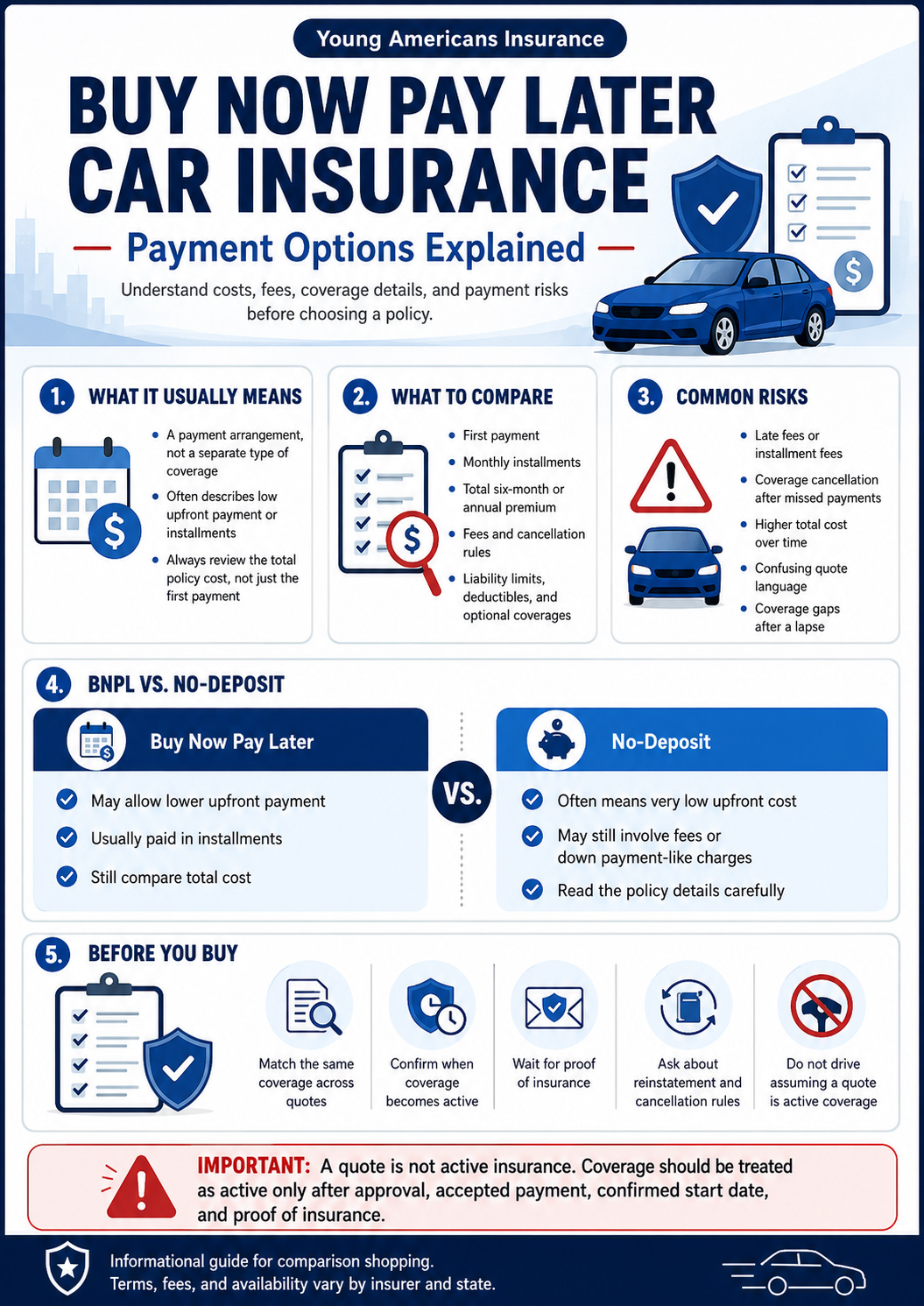
The two phrases describe different questions. BNPL concerns whether a balance is being financed or repaid over time, while “no deposit” language generally focuses on the amount required at the beginning of the insurance transaction.
A low-upfront car insurance arrangement marketed as “no deposit” may still require an initial premium payment or another accepted billing arrangement before the insurer binds coverage.
| Phrase | Main Question | What It Does Not Prove |
|---|---|---|
| Buy now, pay later | Is a purchase being financed or divided into later payments? | It does not identify the insurance coverage being purchased. |
| No deposit | How much is required initially? | It does not necessarily mean zero dollars are required. |
| Monthly payments | Is the insurance premium collected through installments? | Monthly billing does not automatically mean a BNPL lender is involved. |
How an Insurer Installment Plan Works
Insurance companies may allow the premium for a longer policy term to be divided into monthly or other scheduled payments. The NAIC Consumer’s Guide to Auto Insurance notes that many insurers allow monthly payments and that an additional billing fee may apply. [3]
This is a billing arrangement between the policyholder and insurer or its billing provider. It should not automatically be described as a loan.
For an insurer payment plan, confirm:
- The amount required initially.
- The number of remaining installments.
- The amount and due date of each installment.
- Any installment or service charge.
- Whether automatic payment is required.
- What happens if a payment is returned or late.
- How cancellation for nonpayment works under the policy and state rules.
How Premium Financing Is Different
Premium financing introduces a lender between the policyholder and the insurance premium. The lender may fund the premium, while the policyholder makes scheduled repayments to the finance company.
This means there can be two separate contracts to understand: the insurance policy and the premium finance agreement. The finance agreement may contain interest, fees, default provisions, and rights that do not exist in the insurer’s ordinary billing plan. [4]
A payment sent to a premium finance company is not the same transaction as a premium installment paid directly to the insurer. Confirm the lender name, insurer name, amount financed, finance charges, payment dates, and what the agreement says can happen after default.
What If a True BNPL Lender Is Involved?
If a separate lender actually offers BNPL for an insurance transaction, the credit agreement should be evaluated independently from the insurance policy.
CFPB notes that BNPL loans can involve late fees and that unpaid balances may eventually be sent to collections or reported to a consumer reporting company, depending on the lender and product. [1]
Missing a BNPL loan payment does not automatically mean the same thing as missing an insurance premium payment. Whether insurance coverage is affected depends on how the transaction was structured and whether the insurer actually received the required premium.
When Is the Insurance Policy Actually Active?
A quote is only an estimate. Entering payment information or submitting an application does not by itself prove that coverage has begun.
NAIC notes that some online insurance systems can make coverage available immediately while others cannot, even after a premium payment has been submitted. [5]
| Stage | What It Means |
|---|---|
| Quote | An estimated price based on the information supplied so far. |
| Application submitted | The consumer has requested coverage, but underwriting or other review may still be incomplete. |
| Payment authorized | A payment method has been provided or a transaction initiated; this alone does not establish the policy’s effective time. |
| Policy bound | The insurer or authorized party has agreed to provide coverage subject to the policy terms. |
| Effective date and time | The point at which the bound policy’s coverage begins. |
| Proof of insurance | Evidence of the policy that should correspond with the actual effective coverage period. |
Confirm that the insurer has bound the policy and that its effective date and time have begun. Then obtain the applicable insurance card or other proof of coverage.
Compare the Total Cost, Not Just the First Payment
A small initial payment can improve short-term cash flow without necessarily reducing the total cost of insurance. The useful comparison is the complete amount paid under the policy and, when credit is involved, the complete cost of the credit agreement.
Confirm what must be paid or authorized before the insurance policy can be bound.
Identify the complete premium for the insurance term rather than only the monthly payment.
Check installment or service charges imposed by the insurer or billing provider.
When premium financing or other credit is involved, identify interest, lender fees, and other borrowing costs separately.
Confirm every remaining installment rather than assuming they match the first payment.
Understand what happens when an insurance payment or credit repayment is missed.
Missed Payments Can Have Different Consequences
The consequences of missing a payment depend on which payment was missed. A late insurance-premium installment, a default under a premium finance agreement, and a missed BNPL loan payment are not necessarily governed by the same contract.
| Missed Payment | Possible Consequence | What to Check |
|---|---|---|
| Insurer premium installment | Nonpayment can lead to cancellation under the policy and applicable state requirements. | Due date, notice provisions, cancellation effective date, and reinstatement rules. |
| Premium finance payment | The finance agreement may provide default remedies and, depending on the agreement and applicable law, may affect the insurance policy. | Finance agreement, notice provisions, fees, and cancellation authority. |
| BNPL loan payment | The lender may charge fees, restrict further use, pursue collection, or report the debt depending on the product. | Loan terms and whether the insurer’s premium has already been funded independently. |
NAIC’s consumer guide explains that nonpayment of premium is a common reason an auto insurer may cancel coverage after the applicable initial period and that advance-notice requirements vary by state. [3]
If insurance coverage ends, losses occurring outside the effective policy period may not be covered. If a separate credit balance remains unpaid, the borrower may also continue to owe money under the credit agreement.
Payment Details to Confirm Before Agreeing
- Who is receiving each payment: insurer, agency, billing company, premium finance lender, or BNPL lender?
- What amount is required before the insurance policy can become effective?
- What is the complete policy-term premium?
- How much is each later payment and when is it due?
- Which charges are insurance billing fees and which are finance or credit charges?
- Is automatic payment required?
- What happens after a declined or returned payment?
- What notice applies before an insurance policy can be canceled?
- What default provisions apply to any separate financing agreement?
The Payment Method Does Not Change the Insurance Coverage
A payment arrangement changes how the premium is collected or financed; it does not automatically change what the insurance policy covers. Liability limits, collision and comprehensive coverage, deductibles, uninsured motorist protection, exclusions, and other terms still need to be evaluated separately.
Coverage
Determines which qualifying losses the policy addresses.
Premium
Represents the insurance price charged for the policy.
Financing
Determines how borrowed or deferred amounts are repaid when a separate credit arrangement exists.
When Paying the Premium Over Time May Fit the Budget
An installment arrangement can reduce the cash required at one time, but that benefit should be considered against later payment obligations and any additional charges.
A payment arrangement is easier to evaluate when:
- The complete premium is known.
- Every installment amount is clearly disclosed.
- Billing or finance charges are identified separately.
- The later payments fit the expected budget.
- The insurer and any lender are clearly identified.
- Cancellation and default provisions are understandable.
Drivers whose main concern is obtaining coverage immediately rather than financing a premium may be dealing with a different problem, because same-day coverage with later installment payments depends heavily on the insurer’s binding and effective-time requirements.
Payment Arrangement Red Flags
If credit is involved, the borrower should know which company is providing it and receive the applicable agreement.
A payment provider or website name does not necessarily identify the insurance company writing the policy.
The initial amount does not show the complete insurance or financing cost.
Insurance billing charges and lender finance charges should be distinguishable.
Payment submission does not prove that the insurance has already taken effect.
Understand separately what happens to the insurance policy and what happens to any outstanding credit balance.
Final Thoughts on Buy Now Pay Later Car Insurance
“Buy now, pay later car insurance” is best treated as a search phrase rather than the name of one standardized insurance product. An insurer installment plan, premium financing agreement, and BNPL loan can all spread payments over time while creating different legal and financial obligations.
Before agreeing to any arrangement, identify the insurer, identify any lender, confirm the complete premium and financing cost, understand the payment schedule, and verify the policy’s actual effective date and time.
Simple rule
Separate the insurance policy from the payment agreement. Compare the coverage and premium on one side, then compare billing or financing terms on the other.
Compare Auto Insurance Options by ZIP Code
Compare the insurance policy itself before deciding whether an available installment or financing arrangement fits your budget.
Quote availability is provided through a third-party partner. YoungAmericansInsurance.com does not itself offer a BNPL loan, premium finance agreement, or insurance policy. Available payment arrangements depend on the provider involved.
Frequently Asked Questions
Is buy now pay later car insurance a real insurance product?
The phrase is used online, but it does not identify one standardized type of auto insurance. It can be used loosely for insurer installment billing, premium financing, or, in some situations, a separate credit product.
Is monthly car insurance billing the same as BNPL?
No. An insurer can divide a policy premium into monthly installments without a BNPL lender being involved. A true BNPL arrangement is a form of credit.
What is premium financing?
Premium financing involves a separate lender paying an insurance premium on behalf of the policyholder, who then repays that lender according to a finance agreement that can include interest and fees.
Is BNPL the same as no-deposit car insurance?
No. No-deposit language generally relates to how much money is required initially, while BNPL refers to a credit arrangement that spreads a purchase balance over later payments.
Can a missed BNPL payment cancel my car insurance?
Not automatically. Missing an insurer premium installment can affect the policy, while missing a separate BNPL loan payment primarily creates consequences under the credit agreement. Premium financing can involve additional cancellation provisions.
Does paying in installments always cost more?
Not necessarily. Insurer billing plans can include installment charges, premium financing can include interest and fees, and a separate BNPL product has its own terms. Compare the complete amount payable under each arrangement.
What should I confirm before relying on the insurance?
Confirm the actual insurer, policy number, coverage selections, amount required initially, policy effective date and time, payment schedule, and valid proof of insurance.
YoungAmericansInsurance.com publishes general educational information. Insurance installment plans, premium financing, BNPL credit terms, payment fees, cancellation procedures, coverage availability, and underwriting vary by provider and state. Confirm insurance terms with the insurer or licensed provider and credit terms with the lender responsible for the financing agreement.
References
- [1] Consumer Financial Protection Bureau, “What Is a Buy Now, Pay Later (BNPL) Loan?” ConsumerFinance.gov ↩ ↩
- [2] California Department of Insurance, “Glossary of Insurance Terms — Premium Financing.” Insurance.ca.gov ↩
- [3] National Association of Insurance Commissioners, “A Consumer’s Guide to Auto Insurance.” NAIC.org ↩ ↩
- [4] California Department of Insurance, “Standard Broker Disclosure.” Insurance.ca.gov ↩
- [5] National Association of Insurance Commissioners, “Comparing Online Auto Insurance Quotes.” NAIC.org ↩