
By YoungAmericansInsurance.com Editorial Team
Published on
Updated on
Editorial details
This article was reviewed for Montana liability requirements, uninsured motorist rules, insurance verification, rating factors, coverage terminology, policy cancellation information, and consumer clarity.
YoungAmericansInsurance.com publishes general educational information. Premiums, underwriting, discounts, coverage availability, deductibles, and policy terms vary by insurer and applicant.
Finding lower-cost car insurance in Montana starts with understanding the state’s minimum liability requirement and then looking at the differences between actual quotes. Two policies with different limits, deductibles, optional coverages, or driver information are not equivalent simply because one has a lower premium.
Montana drivers should also understand uninsured motorist coverage, insurance verification, factors that can affect premiums, and what happens when collision or comprehensive coverage is added or removed.
Montana Car Insurance Requirements
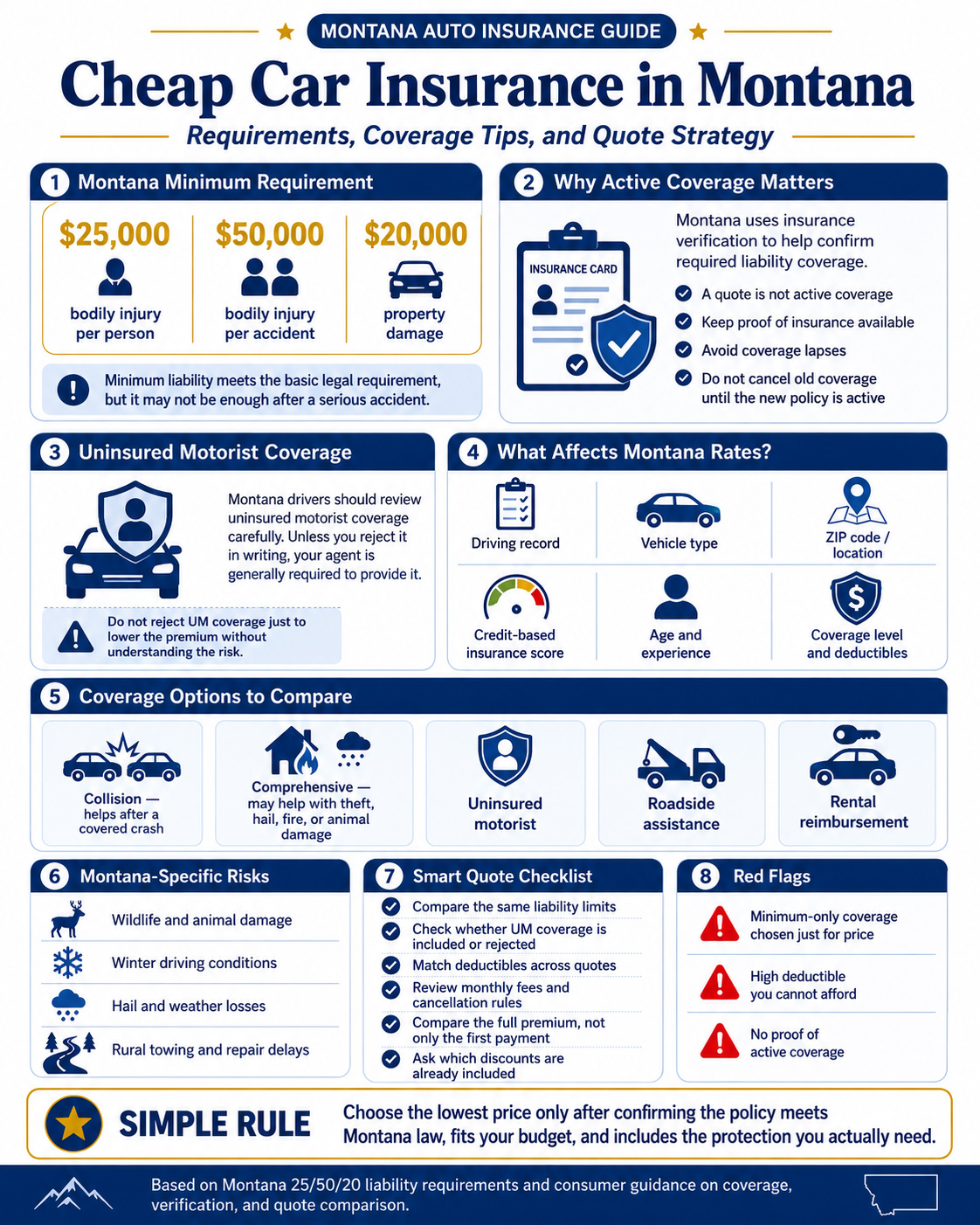
Montana law requires a motor vehicle operated on public roads to have a liability insurance policy meeting the state’s minimum limits. The Montana Motor Vehicle Division lists those limits as 25/50/20. [1]
| Liability Coverage | Montana Minimum | What the Limit Applies To |
|---|---|---|
| Bodily injury or death — one person | $25,000 | Liability for bodily injury or death of one person in one accident, subject to policy terms. |
| Bodily injury or death — one accident | $50,000 | Total bodily injury or death liability involving two or more people in one accident. |
| Property damage — one accident | $20,000 | Liability for injury to or destruction of another person’s property in one accident. |
The 25/50/20 figures describe liability limits; they do not describe every part of an auto policy. Terms such as liability limits, deductibles, and other basic auto insurance terms help distinguish Montana’s minimum requirement from optional protection for the insured vehicle and other losses.
A policy meeting 25/50/20 can satisfy Montana’s minimum liability-limit requirement, but a higher liability limit provides a larger amount available for an eligible covered liability claim. The appropriate limit depends on the policyholder’s circumstances and available insurance options.
What a Lower-Cost Montana Auto Insurance Quote Can Mean
A lower quoted premium can result from many differences. It may reflect lower liability limits, different deductibles, fewer optional coverages, a different vehicle or driver profile, discounts, or simply a different insurer’s rating methodology.
| Quote Difference | Possible Effect | What to Check |
|---|---|---|
| Lower liability limits | Can reduce the amount available under the policy for eligible liability claims. | Whether both quotes use the same bodily injury and property damage limits. |
| Higher physical-damage deductible | Can reduce the collision or comprehensive premium. | How the deductible applies to an eligible covered loss. |
| Different optional coverages | Can change both premium and the types of losses addressed. | Whether collision, comprehensive, rental reimbursement, or other optional protection is included. |
| Discounts | Can change the premium when the applicant meets the insurer’s eligibility rules. | Which discounts are already included and whether documentation is required. |
| Different rating information | A change in drivers, vehicle use, mileage, address, or other information can change the quote. | Whether the underlying information is consistent. |
For a useful price evaluation, use consistent driver, vehicle, mileage, liability-limit, deductible, and optional-coverage information whenever possible.
Montana Insurance Verification and Proof of Coverage
Montana operates the Montana Insurance Verification System, or MTIVS. The Motor Vehicle Division says the system uses Montana registration information and data supplied by insurers to confirm whether a vehicle has the required minimum liability insurance. [1]
Montana motorists stopped for a traffic violation or involved in a motor vehicle collision can also be required to show proof of insurance to law enforcement. [1]
Policy-status details to confirm
- The correct vehicle is listed on the policy.
- The VIN and registration information are accurate.
- The policy effective date and time have begun.
- The insurer has actually bound the coverage.
- Valid proof of insurance is available.
- Replacement coverage begins before an existing policy is intentionally ended.
Confirm that the insurer has bound the policy and that the effective date and time have begun. Proof of insurance should then reflect that active policy.
Uninsured Motorist Coverage in Montana
Montana treats uninsured motorist coverage differently from an ordinary optional add-on. Montana Code Annotated § 33-23-201 generally requires a qualifying motor vehicle liability policy for a vehicle registered and principally garaged in Montana to include uninsured motorist bodily-injury coverage unless the named insured rejects it. [2]
The Montana Commissioner of Securities and Insurance similarly explains that unless the consumer signs a form stating that uninsured motorist coverage is not wanted, the agent is required to provide it. [3]
Check the available limits, covered bodily-injury losses, premium effect, exclusions, and policy terms before deciding whether to reject uninsured motorist coverage.
What Montana Liability Insurance Does and Does Not Address
Liability insurance primarily addresses eligible bodily injury or property damage for which the insured becomes legally responsible, subject to the policy’s limits and conditions. It does not automatically provide physical-damage coverage for the insured vehicle.
| Loss or Situation | Coverage Commonly Associated With It | Important Detail |
|---|---|---|
| Damage to another person’s property after an at-fault accident | Property damage liability | Subject to the selected liability limit and policy terms. |
| Damage to your vehicle from a covered collision | Collision | Usually subject to the collision deductible and other policy provisions. |
| Theft, fire, hail, vandalism, or animal collision | Comprehensive | Coverage depends on the contract and generally involves a comprehensive deductible. |
| Eligible bodily injury caused by an uninsured driver | Uninsured motorist coverage | Montana’s statutory offer and rejection rules apply to qualifying policies. |
| Temporary transportation after an eligible covered loss | Rental reimbursement, if purchased | Limits, covered circumstances, and duration vary by policy. |
Additional Auto Coverage in Montana
Adding physical-damage or other optional coverage changes what the policy can address as well as its price. The Montana CSI describes comprehensive coverage as typically addressing losses such as fire, theft, glass breakage, animal collision, and other losses not covered by collision. [3]
Theft, hail, fire, vandalism, animal strikes, and similar events are generally associated with comprehensive protection for vehicle damage . The applicable deductible, exclusions, and policy terms still determine how a particular loss is handled.
Collision
Addresses eligible physical damage from a covered collision or overturn, subject to the policy and deductible.
Comprehensive
Addresses certain eligible losses other than collision according to the contract.
Other optional coverage
Rental reimbursement, roadside assistance, medical payments, and other options may be available depending on the insurer and policy.
Older and Paid-Off Vehicles
Paying off a vehicle can remove a lender’s contractual requirement for certain physical-damage coverage, but it does not determine whether collision or comprehensive coverage is financially appropriate for the owner.
Instead, consider the vehicle’s value, the cost of the coverage, the applicable deductible, and the amount of a potential vehicle loss the household could absorb without insurance reimbursement.
It should not be treated simply as cash that is always handed directly to the insurer. Depending on the claim, the deductible represents the policyholder’s portion of an eligible covered loss or reduces the claim payment.
Factors That Can Affect Car Insurance Premiums in Montana
Montana’s Commissioner of Securities and Insurance says premium quotes can depend on factors including where the driver lives, the vehicle, mileage, amount of coverage, driving record, age, marital status, and gender. [3]
| Rating Information | What to Keep Accurate |
|---|---|
| Garaging location | The actual address where the vehicle is principally kept. |
| Vehicle | Correct year, make, model, VIN, ownership, and requested use. |
| Mileage and vehicle use | A realistic mileage estimate and accurate description of how the vehicle is driven. |
| Driving record | Requested ticket, accident, and licensing information. |
| Coverage | Liability limits, physical-damage coverage, deductibles, and optional selections. |
| Driver information | Accurate age and other information requested by the insurer under applicable Montana rating rules. |
Credit Information and Montana Auto Insurance
The Montana CSI notes that insurers may use certain aspects of credit information to create an insurance credit score when evaluating insurance risk. [3]
That does not mean a consumer credit score translates directly into a particular premium. If credit information affects underwriting or pricing, ask the insurer what information was used and what consumer rights or notices apply.
Discounts and Other Montana Car Insurance Cost Factors
Discounts are insurer-specific and should not be assumed to apply automatically. NAIC consumer guidance identifies examples that companies may offer, including multiple vehicles, qualifying driver-education courses, good-student eligibility, safety equipment, anti-theft devices, and combining auto with another qualifying policy. [4]
Items worth checking on the quote
- Which discounts have already been applied.
- Which discounts require documents or continuing eligibility.
- Whether more than one qualifying vehicle affects the premium.
- Whether combining auto with another policy changes the total cost.
- Whether approved driver education or good-student status qualifies.
- Whether vehicle safety or anti-theft equipment qualifies.
- Whether changing collision or comprehensive deductibles changes the premium enough to justify the additional policyholder share of a covered loss.
The useful number is the complete policy-term cost after applicable discounts and charges, not simply an advertised monthly installment.
Different Driver Situations Can Produce Different Montana Quotes
There is no single insurer or policy structure that will be lowest-priced for every Montana driver. Driver age, experience, vehicle, location, household composition, driving record, coverage selections, and insurer rating rules can all change the result.
| Driver Situation | Information That Can Matter |
|---|---|
| Young or newly licensed driver | Age, experience, vehicle, driving record, household drivers, applicable student or training discounts, and coverage choices. |
| Older paid-off vehicle | Vehicle value, liability limits, physical-damage premium, and applicable deductibles. |
| Multiple-vehicle household | Drivers, vehicle assignments, total household premium, and available multi-vehicle discounts. |
| Driver with prior incidents | Driving record, claim history requested by the insurer, and the carrier’s underwriting rules. |
Households insuring a younger driver can also consider affordable car insurance options for young drivers within the same process, while keeping Montana’s liability requirements and the actual household information consistent.
Nonpayment and Policy Cancellation in Montana
Payment problems should be separated from the question of whether a policy is currently active. The Montana CSI states that an insurer must send at least 10 days’ advance notice when canceling a policy for nonpayment of premium, while other cancellation or nonrenewal circumstances can involve different notice requirements. [3]
A late or failed payment does not by itself tell you the precise moment coverage ends. Check the insurer’s notice, applicable policy terms, and effective cancellation date.
If replacing a policy, confirm that the new insurer has bound coverage and that the new effective date and time have begun before intentionally ending the existing coverage.
Information to Prepare for a Montana Auto Insurance Quote
Quotes are more meaningful when the underlying information is complete and consistent. NAIC guidance emphasizes providing correct information because the quoted premium is based on the details supplied by the consumer. [4]
Quote information checklist
- Driver names, dates of birth, and license information.
- Driving-history information requested by the insurer.
- Vehicle year, make, model, VIN, and ownership status.
- Correct Montana garaging address.
- Expected annual mileage and vehicle use.
- Other household drivers requested on the application.
- Desired liability limits.
- Collision and comprehensive selections and deductibles.
- Uninsured motorist selection or rejection status.
- Documentation required for any claimed discount.
How to Evaluate Montana Auto Insurance Quotes
Price differences are easier to understand when the quotes use the same or similar coverage. NAIC guidance recommends shopping among companies, considering factors beyond price, and checking that policy information and discounts are accurate. [4]
Check whether each quote uses the same bodily-injury and property-damage limits.
Determine whether UM coverage is included or has been rejected.
Check whether collision and comprehensive are present on each quote.
Keep applicable deductibles consistent when evaluating price differences.
Confirm the same drivers, vehicles, address, and vehicle use are being rated.
Look at the total quoted premium and applicable charges instead of evaluating only an installment amount.
Before Starting a Montana Auto Insurance Policy
Final policy checklist
- Confirm that the liability limits meet Montana’s 25/50/20 minimum.
- Confirm how uninsured motorist coverage is shown on the policy.
- Check that all required drivers and vehicles are listed accurately.
- Confirm collision and comprehensive if required by a financing or lease agreement.
- Understand how each applicable deductible works.
- Verify which discounts are included.
- Check the complete policy-term premium and applicable billing charges.
- Confirm that the policy is bound and note the effective date and time.
- Obtain valid proof of insurance.
Montana Auto Insurance Quote Options
Enter a ZIP code to continue to a third-party auto insurance quote provider. Available insurers, premiums, and coverage options depend on the applicant and participating providers.
Quote availability is provided through a third-party partner. YoungAmericansInsurance.com does not underwrite or issue the insurance policies displayed through the quote process. Pricing and coverage depend on participating providers and applicant information.
Frequently Asked Questions
What is the minimum car insurance required in Montana?
Montana’s minimum motor vehicle liability limits are $25,000 for bodily injury or death of one person, $50,000 for bodily injury or death of two or more people in one accident, and $20,000 for property damage in one accident. These limits are commonly written as 25/50/20.
What does Montana’s 25/50/20 liability requirement cover?
The numbers represent maximum liability limits for bodily injury or death and property damage under an eligible covered claim. They do not automatically include collision or comprehensive coverage for the insured vehicle.
Does Montana require uninsured motorist coverage?
Montana law generally requires qualifying motor vehicle liability policies to include uninsured motorist bodily-injury coverage, but the named insured has the right to reject that coverage.
What is MTIVS?
MTIVS is Montana’s motor vehicle insurance verification system. It uses vehicle registration information and insurer data to help confirm whether a vehicle has the required minimum liability insurance.
What should I consider before removing collision or comprehensive from an older car?
Consider the vehicle’s value, the premium for the coverage, applicable deductibles, any financing or lease requirements, and the amount of a vehicle loss you could absorb without insurance reimbursement.
What factors can affect a Montana car insurance quote?
Montana’s insurance regulator identifies factors including location, vehicle, mileage, amount of coverage, driving record, age, marital status, and gender. Insurer underwriting and rating rules can also produce different premiums for the same applicant.
Does a late payment immediately cancel Montana auto insurance?
Not necessarily. Montana’s insurance regulator states that insurers must provide advance notice for cancellation due to nonpayment. Check the actual cancellation notice and effective date rather than assuming the policy ended when the payment was missed.
How should Montana auto insurance prices be evaluated?
Use consistent drivers, vehicles, mileage, liability limits, deductibles, and optional coverages. Then check the complete policy-term premium, discounts, and applicable charges so that differences between quotes reflect similar coverage.
Final Thoughts on Cheap Car Insurance in Montana
Montana’s 25/50/20 limits establish the starting point for required liability coverage, but they do not determine the full structure of an auto policy. Uninsured motorist coverage, collision, comprehensive, deductibles, driver information, discounts, and insurer rating rules can all change both the coverage and the premium.
The lowest-priced quote may not contain the same limits, deductibles, or optional coverages as another quote. Keeping the underlying information consistent makes those differences easier to understand before a policy is started.
This article provides general educational information about Montana auto insurance. Insurance requirements can change, and premiums, underwriting, available coverages, discounts, deductibles, billing arrangements, and policy terms vary by insurer and applicant. Current Montana requirements should be confirmed with the appropriate state agency or licensed insurance provider.
References
- [1] Montana Motor Vehicle Division, “Vehicle Insurance and Verification.” Montana MVD ↩ ↩ ↩
- [2] Montana Code Annotated § 33-23-201, “Motor Vehicle Liability Policies to Include Uninsured Motorist Coverage — Rejection by Insured.” Montana Legislature ↩
- [3] Montana Commissioner of Securities and Insurance, “Auto Insurance.” Montana CSI ↩ ↩ ↩ ↩ ↩
- [4] National Association of Insurance Commissioners, “Tips for Saving on Your Auto Insurance.” NAIC ↩ ↩ ↩