
No car is guaranteed to be the cheapest to insure for every teenager. A useful starting point is to compare safe, practical vehicles with moderate value, reasonable repair costs, non-performance trims, and model years supported by current safety research.
The ten vehicles below appear on the 2026 IIHS and Consumer Reports recommendations for teen drivers. Always request a quote for the exact VIN before purchasing because insurance prices vary by driver, location, model year, trim, mileage, coverage, and insurer.
10 Used Cars Teens Should Quote First
This table is not a ranking of insurance premiums. It identifies practical used vehicles from the current IIHS/Consumer Reports teen recommendations that families may want to quote before buying. “Best Choice” and “Good Choice” are safety-list categories, not insurance-price guarantees. [1]
| Vehicle | Model Years to Research | IIHS/CR Category | Why It May Be Worth Quoting | Insurance Check |
|---|---|---|---|---|
| Mazda 3 | 2014–18; hatchback 2019–25; sedan 2020–25 | Good Choice and Best Choice | Practical compact available as a sedan or hatchback, with newer years in the higher recommendation tier. | Compare body style, trim, safety equipment, and repair costs. |
| Honda Civic | 2014–25 coupe or sedan | Good Choice | Common compact with broad used-market availability and many non-performance configurations. | Avoid assuming sport-oriented trims will cost the same as standard trims. |
| Subaru Legacy | 2015–19; 2020–25 | Good Choice and Best Choice | Midsize sedan with model years represented in both recommendation tiers. | Ask how AWD, sensors, trim, and comprehensive coverage affect the quote. |
| Toyota Camry | 2019–25, including hybrid | Best Choice | Mainstream midsize sedan with practical family use and current recommended years. | Compare gasoline and hybrid versions separately using the exact VIN. |
| Subaru Outback | 2020–25, built after October 2019 | Best Choice | Offers midsize protection and cargo utility without moving into a large SUV. | Review vehicle value, AWD repair costs, and physical-damage premiums. |
| Mazda CX-5 | 2014–17, built after October 2013; 2018–25, built after March 2018 | Good Choice and Best Choice | Compact SUV with a wide range of recommended used years. | Verify build date, trim, driver-assistance equipment, and deductible choices. |
| Subaru Forester | 2019–25 | Best Choice | Practical small SUV with visibility, cargo room, and several recommended model years. | Compare trim, AWD-related repair costs, mileage, and garaging location. |
| Nissan Sentra | 2015–25 | Good Choice | Lower-priced compact on the current teen vehicle list with broad year availability. | Quote the exact generation and safety equipment rather than relying on the model name alone. |
| Hyundai Elantra | 2017–25 | Good Choice | Common compact with a substantial range of recommended model years. | Check theft experience, anti-theft equipment, trim, and local insurer eligibility. |
| Chevrolet Malibu | 2014–25 | Good Choice | Midsize sedan with many used years represented on the current list. | Compare model year, vehicle value, safety features, mileage, and repair history. |
The prices published by IIHS for its used-vehicle list are estimated vehicle purchase prices, not insurance premiums. This article does not use those purchase prices to claim that one model will always have the lowest insurance rate.
How We Selected These Vehicles
We started with the IIHS and Consumer Reports teen vehicle recommendations updated May 27, 2026. The organizations evaluate used vehicles for crash protection, braking, emergency and routine handling, control usability, vehicle weight, and electronic stability control. Higher-tier used choices also meet stricter headlight and automatic emergency braking criteria. [2]
From that list, we selected ten mainstream cars and small SUVs with practical body styles and multiple used model years. We did not rank them by premium because insurance pricing requires driver-specific and vehicle-specific data that cannot be determined from a model name alone.
Current safety list
Every vehicle in the main table appears on the current IIHS/Consumer Reports recommendations for teen drivers.
Practical vehicle types
The selection focuses on mainstream compact cars, midsize sedans, and small SUVs rather than performance or luxury vehicles.
Quote before buying
Inclusion means the vehicle is worth researching, not that it is guaranteed to have the lowest insurance premium.
Insurance Loss History Also Matters
Safety recommendations are only one part of vehicle selection. Insurance experience can differ substantially between models because collision, theft, repair costs, injury claims, and claim severity vary from one vehicle to another. The Highway Loss Data Institute publishes insurance loss results by make and model across several major auto insurance coverages.
Those loss results are not the same as an individual insurance quote. A teenager’s premium still depends on the driver, ZIP code, household, driving record, model year, trim, coverage, deductibles, discounts, and insurer. They do provide another useful vehicle-level signal alongside crash protection, repair considerations, and the exact VIN.
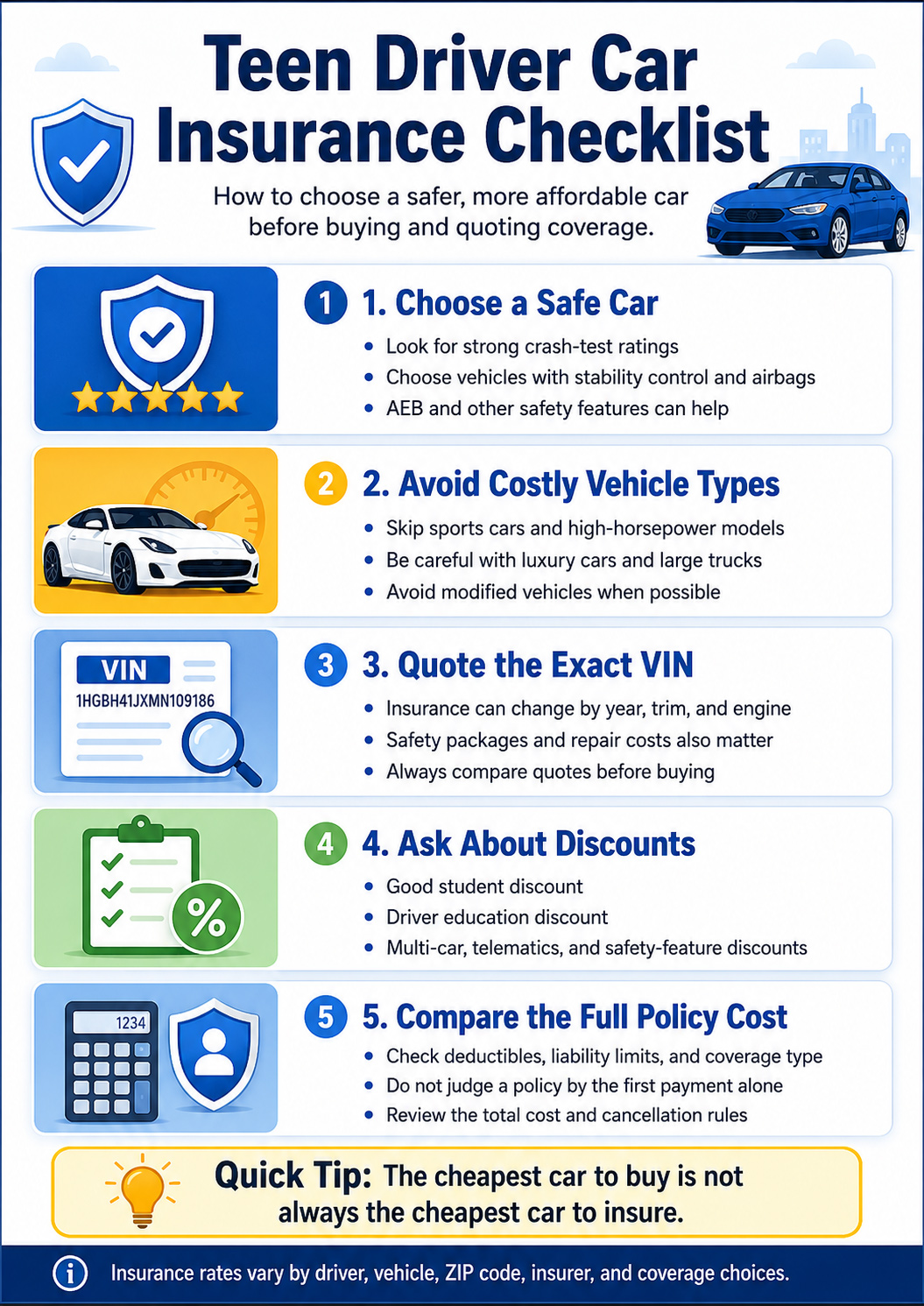
What Can Make a Teen’s Car Less Expensive to Insure?
Insurance companies may consider vehicle value, repair or replacement cost, theft experience, safety equipment, performance, and special features. The NAIC notes that cars that cost more to repair or replace, higher-value vehicles, frequently stolen cars, and sports cars may cost more to insure. [3]
| Vehicle Characteristic | Why It May Help | What to Verify |
|---|---|---|
| Mainstream model | Parts, repair information, and replacement vehicles may be more widely available. | Actual repair costs still vary by generation, trim, and location. |
| Moderate vehicle value | A less valuable vehicle may cost less to repair or replace than a new luxury model. | Do not sacrifice crash protection merely to lower the purchase price. |
| Non-performance trim | Lower horsepower and less expensive equipment may reduce some underwriting concerns. | Insurers rate the exact trim and engine, not only the model name. |
| Strong safety equipment | Crash protection and crash-avoidance features may reduce risk and may qualify for certain discounts. | Confirm which features are standard on the exact year and trim. |
| Lower theft exposure | Lower theft frequency may help comprehensive pricing or eligibility. | Theft patterns and insurer rules vary by ZIP code and model year. |
| Unmodified condition | A stock vehicle may be easier to value, underwrite, repair, and replace. | Disclose aftermarket wheels, suspension, performance, or appearance modifications. |
Vehicle choice is only one part of the premium. Age, driving experience, record, annual mileage, garaging address, coverage, deductibles, and discounts also shape car insurance costs for young drivers , so two teenagers driving the same model can still receive very different quotes.
Best Vehicle Types for Teen Drivers to Compare
A practical midsize car, compact car with strong safety credentials, or small SUV may offer a useful balance of occupant protection, maneuverability, value, and repair availability. Very small cars may provide less protection than larger vehicles, while large trucks and SUVs can be more difficult to handle and may create higher purchase, repair, or liability costs.
Compact and midsize sedans
Often widely available, practical, and less costly than luxury or performance models.
Small SUVs
Can provide useful visibility and cargo space without the size of a large SUV.
Newer used vehicles
May balance modern safety equipment with a lower purchase value than a brand-new vehicle.
New Cars vs. Used Cars for Teen Drivers
A used car is not automatically cheaper to insure, and a new car is not automatically the safest financial choice. Compare purchase price, crash protection, driver-assistance equipment, repair costs, financing requirements, deductibles, and the insurance quote together.
| Choice | Potential Advantage | Potential Trade-Off |
|---|---|---|
| Older used car | Lower purchase value and potentially lower physical-damage cost. | May lack modern crash protection or crash-avoidance technology. |
| Newer used car | May balance current safety equipment, reliability, and moderate value. | Collision and comprehensive coverage may still be expensive for a teen. |
| New car | Current safety technology, warranty, and fewer age-related maintenance concerns. | Higher value can increase collision and comprehensive premiums. |
| Financed or leased vehicle | May make a newer vehicle accessible. | The lender or lease generally requires collision and comprehensive coverage. |
A higher deductible can reduce the premium, but the way a car insurance deductible works also determines how much the household must pay after a covered loss. That out-of-pocket amount should remain affordable when comparing a newer or more valuable vehicle.
Cars Teen Drivers Should Be Careful With
The following categories are not automatically uninsurable, but they can work against a family seeking a practical first vehicle and manageable insurance costs.
| Vehicle Category | Why It Can Be a Problem | Better Comparison |
|---|---|---|
| Sports and muscle cars | Higher horsepower, performance equipment, and costly repairs may increase premiums. | Quote a standard sedan, hatchback, or small SUV. |
| Luxury vehicles | Parts, sensors, labor, bodywork, and replacement costs can be high. | Compare a mainstream model with similar safety equipment. |
| Large pickups and SUVs | Size, value, handling, fuel cost, repair cost, and liability exposure may be greater. | Choose the smallest practical vehicle that still provides appropriate occupant protection. |
| Very old vehicles | They may lack electronic stability control, side airbags, strong crash protection, or modern AEB. | Use the current teen vehicle list to identify safer used years. |
| Modified vehicles | Performance tuning, suspension changes, custom parts, and altered values can complicate underwriting and claims. | Keep the vehicle stock and disclose all modifications. |
Quote the Exact VIN Before Buying
A quote based on the exact vehicle and VIN provides more vehicle-specific pricing information than one based only on a similar model. The NAIC recommends verifying information such as year, make, model, and VIN because those details are used when developing an insurance quote. [4]
Teen vehicle quote checklist
- Exact year, make, model, trim, engine, body style, and VIN.
- Teen driver’s license status, age, driving record, and prior coverage.
- Whether the teen will be the principal or occasional driver.
- Correct garaging ZIP code and realistic annual mileage.
- Matching liability limits on every quote.
- Matching collision and comprehensive deductibles.
- The same optional coverages and household drivers.
- Discounts applied and documentation required.
- Total policy cost, fees, payment schedule, and effective date.
Using the same driver, vehicle, mileage, coverage limits, deductibles, and household information across insurers makes car insurance quote comparisons for young drivers more meaningful because each price is based on substantially equivalent information.
Vehicle-specific risks also affect which coverage matters. Theft, vandalism, hail, fire, animal damage, and other covered non-collision losses generally fall under comprehensive car insurance, subject to the policy terms and deductible.
Frequently Asked Questions
What cars are usually cheaper to insure for teens?
There is no universal cheapest model. Practical non-performance vehicles with moderate value, reasonable repair costs, strong safety features, and lower theft exposure may be useful places to start. Compare the exact VIN for the teen’s profile and ZIP code.
Why are Toyota Corolla and Honda CR-V not in the main table?
Our table is limited to vehicles appearing on the current 2026 IIHS and Consumer Reports teen recommendations. Other vehicles may still be worth quoting, but they should be evaluated using current safety ratings, model-year details, repair costs, and an exact insurance quote.
Is a used car always cheaper to insure for a teenager?
No. A lower vehicle value can reduce some physical-damage costs, but age, safety equipment, theft experience, repair costs, coverage, and driver details can change the result.
Should a teenager drive a very small car?
Not necessarily. IIHS considers vehicle weight and excludes very light vehicles from its recommendations. Families should balance affordability, maneuverability, crash protection, and the teen’s driving needs.
Is liability-only coverage appropriate for a teen’s car?
It may be considered for an older paid-off vehicle the family could afford to replace. It does not protect the insured vehicle against many collision or non-collision losses, and financed or leased vehicles generally require physical-damage coverage.
Should families quote insurance before buying the vehicle?
Yes. Request quotes for the exact VIN, compare matching coverage, and include the insurance cost when evaluating the full monthly and annual cost of the vehicle.
Final Thoughts on Cars to Insure for Teens
The most useful teen vehicle is not simply the cheapest car to buy. It should combine appropriate crash protection, predictable handling, practical value, manageable repair costs, and an insurance premium the household can maintain.
Start with current safety recommendations, narrow the options to practical model years and trims, inspect the vehicle, check recalls and safety ratings, and request an insurance quote for the exact VIN before signing.
The VIN can also identify unresolved safety recalls, which should be checked before purchasing a used vehicle.
Quote the Teen Driver and Exact Vehicle
Enter a ZIP code to continue comparing available auto insurance options for the driver, vehicle, selected coverage, and location.
References
- [1] Insurance Institute for Highway Safety and Consumer Reports, “Safe vehicles for teens,” updated May 27, 2026. Source ↩
- [2] Insurance Institute for Highway Safety, “Updated teen vehicle list spotlights good buys with solid safety credentials,” May 27, 2026. Source ↩
- [3] National Association of Insurance Commissioners, “Consumer Shopping Tool for Auto Insurance.” Source ↩
- [4] National Association of Insurance Commissioners, “Does your vehicle have the right protection? Best practices for buying auto insurance.” Source ↩