
ACCC Insurance Company Current Status
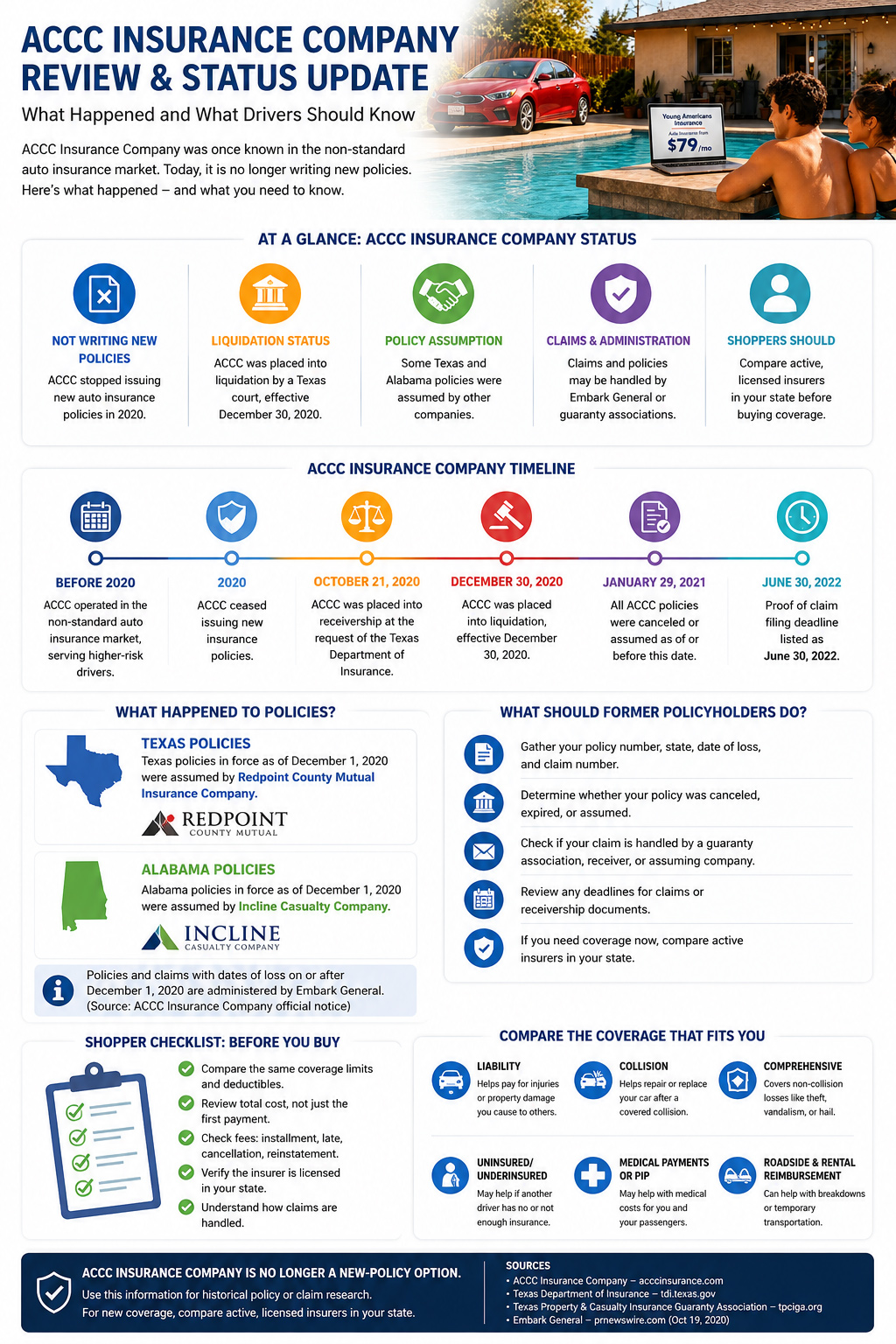
ACCC Insurance Company is no longer a current option for purchasing a new auto insurance policy. The company stopped issuing new policies in 2020, entered liquidation effective December 30, 2020, and its remaining policies were canceled or assumed by other companies by January 29, 2021. [1]
| ACCC Insurance Company Item | Current Status |
|---|---|
| New auto insurance policies | Not available. ACCC ceased issuing new policies in 2020. |
| Liquidation status | ACCC was placed into liquidation effective December 30, 2020. |
| Former policy status | Policies were canceled or assumed as of or before January 29, 2021. |
| Best use of this page | Historical policy research, old claim questions, receivership information, and replacement coverage research. |
| Current shopper action | Compare insurers currently licensed and writing coverage in your state. |
Drivers replacing an old or unavailable policy can use estimated auto insurance costs for replacement coverage as a planning reference before comparing actual quotes from active insurers.
Is ACCC Insurance Company Still Selling Policies?
No. ACCC Insurance Company’s receivership information states that the company ceased issuing new policies in 2020 and that all ACCC policies were canceled or assumed as of or before January 29, 2021. [1]
This distinction matters because old ACCC reviews, agent listings, payment pages, phone numbers, and quote-related pages may still appear in search results. They should not be interpreted as evidence that ACCC is currently writing new auto insurance.
Treat ACCC as a historical insurance-company research topic rather than a current carrier option. A replacement policy should come from an insurer or agency currently authorized to operate in your state.
What Happened to ACCC Insurance Company?
ACCC Insurance Company was placed into liquidation by a Texas court effective December 30, 2020. The Texas Department of Insurance continues to list ACCC Insurance Company among Texas receiverships, with Prime Tempus, Inc. identified as Special Deputy Receiver. [2]
The Texas Property and Casualty Insurance Guaranty Association also identifies ACCC as insolvent and confirms the December 30, 2020 liquidation date. [3]
An insurance-company liquidation is a regulated process for handling the remaining obligations of a company that can no longer operate normally. Depending on the policy, state, and date of loss, a receiver, guaranty association, or assuming insurer may become involved.
ACCC Insurance Company Timeline
The timeline helps explain why historical ACCC policy documents, payment pages, claims contacts, and reviews should be interpreted according to their date.
| Date or Period | What Happened | Why It Matters |
|---|---|---|
| Before 2020 | ACCC operated in the non-standard auto insurance market. | Historical consumer reviews generally describe this earlier period. |
| 2020 | ACCC ceased issuing new policies. | It stopped being a new-policy option. [1] |
| October 2020 | Embark General reported that ACCC had been placed into receivership on October 21, 2020 at the request of the Texas Department of Insurance. | The receivership preceded the later liquidation. [4] |
| December 30, 2020 | ACCC entered liquidation. | Remaining obligations moved into a regulated liquidation process. [3] |
| January 2021 | All ACCC policies were canceled or assumed as of or before January 29, 2021. | Former policyholders needed to determine who was responsible for their policy or claim. [1] |
| June 30, 2022 | ACCC listed this as the proof-of-claim filing deadline. | Historical creditor or claim issues can be affected by receivership deadlines. [1] |
What Happened to Texas and Alabama ACCC Policies?
ACCC’s official information states that Texas policies in force as of December 1, 2020 were assumed by Redpoint County Mutual Insurance Company, while Alabama policies in force as of that date were assumed by Incline Casualty Company. It also states that qualifying Texas and Alabama claims with dates of loss on or after December 1, 2020 were administered by Embark General. [1]
Embark General separately announced that its subsidiary Nations General Insurance Agency LLC had agreed to assume ACCC’s Texas and Alabama auto insurance business effective December 1, 2020, subject to court approval. [4]
Former Alabama policyholders who now need replacement insurance should evaluate current Alabama auto insurance requirements and coverage options independently of any historical ACCC policy arrangement.
If you had an ACCC policy, check:
- The state where the policy was issued.
- Whether the policy was canceled, expired, or assumed.
- The date of loss for any historical claim.
- Whether a receiver, guaranty association, or assuming company is responsible.
- Any receivership or proof-of-claim deadline that may apply.
- Whether replacement coverage was obtained from another insurer.
The History of ACCC Insurance Company
ACCC Insurance Company was associated with non-standard auto insurance, a market that often serves drivers who have difficulty qualifying for preferred or standard coverage because of accidents, tickets, lapses, limited prior insurance history, filing requirements, or other underwriting factors.
Non-standard insurance can provide an important coverage option, but policies can vary materially in price, limits, fees, payment schedules, cancellation rules, and claims procedures. A low initial payment does not necessarily indicate a lower total policy cost.
Historical reviews need context
Reviews describing ACCC pricing, agents, claims, or service generally relate to periods when ACCC was still operating. They should not be used to evaluate current insurers as though ACCC were still accepting new business.
States Connected to ACCC’s Former Insurance Business
Embark General’s 2020 announcement described ACCC as offering insurance products in Alabama, Georgia, Mississippi, New Mexico, and South Carolina. Texas is also central to ACCC’s history because the company was headquartered in Houston and its receivership and liquidation were handled through Texas. [4]
| State | What Drivers Should Know Now |
|---|---|
| Texas | Certain Texas ACCC policies in force as of December 1, 2020 were assumed by Redpoint County Mutual Insurance Company. |
| Alabama | Certain Alabama ACCC policies in force as of December 1, 2020 were assumed by Incline Casualty Company. |
| Georgia | Current shoppers should compare insurers presently authorized to write Georgia auto insurance. |
| Mississippi | Historical ACCC policy or claim questions may require receivership or guaranty-association information. |
| New Mexico | New shoppers should not rely on outdated ACCC quote pages or inactive agency listings. |
| South Carolina | Embark’s announcement listed South Carolina among the markets where ACCC offered products before liquidation. |
What If You Still Have an Old ACCC Claim?
Historical ACCC claims can be complicated because the appropriate contact may depend on the state, policy status, date of loss, and whether the policy was assumed by another company. ACCC’s receivership information states that pending claims at the time of receivership were transferred to affected state guaranty associations, while certain Texas and Alabama policies and later claims were handled through the assumption arrangement described above. [1]
Information to gather before contacting the appropriate organization
- Policy number and named insured.
- State where the policy was issued.
- Vehicle information and coverage dates.
- Date of loss and claim number, if available.
- Letters from ACCC, Embark General, a guaranty association, receiver, or assuming company.
- Repair estimates, police reports, medical bills, or settlement records.
- Cancellation notices, payment records, or policy-assumption documents.
Do not rely on an old ACCC claims number simply because it still appears online. Use current receivership, guaranty-association, state insurance department, or assuming-company information for the policy and date of loss involved.
What Should Drivers Compare Instead of ACCC Today?
Drivers who need a new policy should compare active insurers rather than attempting to purchase ACCC coverage. The appropriate alternative depends on the state, driving history, vehicle, prior insurance, coverage needs, budget, and whether the driver falls into a standard or non-standard underwriting category.
| Driver Situation | What to Compare | Why It Matters |
|---|---|---|
| Prior accident or ticket | Insurers willing to accept the driving history, available discounts, deductibles, and payment options. | Companies can price violations differently. |
| Coverage lapse | Insurers that accept drivers with prior lapses and clearly state binding and payment requirements. | Prior lapses may affect pricing or eligibility. |
| SR-22 or other filing requirement | Companies able to provide the required filing in the applicable state. | Not every insurer offers every filing type. |
| Low upfront budget | Initial payment, installment fees, total premium, cancellation rules, and later payment amounts. | A low first payment can obscure a higher total cost. |
| Financed or leased vehicle | Collision, comprehensive, deductibles, lienholder requirements, and proof-of-insurance rules. | Lenders commonly require physical-damage coverage. |
How to Compare Non-Standard Car Insurance
Drivers shopping in the non-standard market should compare equivalent policies rather than judging them by the first payment alone. Differences in liability limits, physical-damage coverage, deductibles, fees, and cancellation rules can make two apparently similar quotes materially different.
Quote comparison checklist
- Use the same liability limits across every quote.
- Confirm whether collision and comprehensive coverage are included.
- Choose a deductible you could realistically pay after a covered loss.
- Ask about any state filing fees if a filing is required.
- Compare installment, late, reinstatement, and service fees.
- Confirm how claims are reported and who administers them.
- Verify that the insurer or agency is authorized in your state.
- Compare the full policy-term premium instead of only the first payment.
Younger drivers who fall into a higher-cost underwriting category may find that affordable car insurance options for young drivers depend as much on vehicle choice, household policy structure, discounts, and coverage selections as on the insurer itself.
What Coverage Should Replace an Old ACCC Policy?
Replacement coverage should satisfy applicable state requirements while also reflecting the value of the vehicle and the driver’s financial exposure. Minimum liability requirements may establish a legal baseline, but they do not necessarily protect the insured vehicle or provide enough liability protection after a serious accident.
| Coverage Type | What It Generally Does | Why It Matters |
|---|---|---|
| Liability coverage | Helps pay for covered injuries or property damage caused to others, up to policy limits. | Usually required, although required minimums may provide limited protection. |
| Collision coverage | Helps repair or replace the insured vehicle after a qualifying collision, subject to the deductible. | Often required for financed or leased vehicles. |
| Comprehensive coverage | May cover theft, vandalism, hail, fire, falling objects, and certain other non-collision losses. | Can matter for financed, leased, newer, or difficult-to-replace vehicles. |
| Uninsured or underinsured motorist coverage | May apply when another driver has no insurance or insufficient coverage, depending on state and policy terms. | Can reduce exposure when another driver cannot cover a qualifying loss. |
| Medical payments or PIP | May help with accident-related medical expenses depending on the state and policy. | Requirements and availability vary by state. |
| Roadside or rental reimbursement | May provide towing, roadside help, or temporary transportation under the applicable policy terms. | Can matter for drivers who depend heavily on their vehicle. |
How to Verify an Active Insurance Company
Before replacing an old policy or purchasing new coverage, verify that the insurer, agency, or producer is authorized to operate in your state. State insurance departments commonly provide company information, licensing resources, and consumer complaint assistance.
Before buying, verify:
- The insurer or agency is authorized in your state.
- The quote identifies the actual carrier or agency involved.
- The policy limits match the requested coverage.
- The first payment, later installments, fees, and cancellation rules are clear.
- The current claims and policy-service contacts are available.
- The quote is not relying on an inactive ACCC payment portal, old agency page, or outdated branding.
What Drivers Should Remember About ACCC
ACCC Insurance Company is no longer a new-policy option. It stopped issuing new policies in 2020, entered liquidation effective December 30, 2020, and its remaining policies were canceled or assumed by early 2021. Drivers searching for ACCC today are therefore more likely to need historical policy information, old claim guidance, receivership details, or replacement coverage.
For new insurance, compare currently active providers using equivalent limits and deductibles and pay attention to the complete premium, payment schedule, claims process, and cancellation terms rather than relying on an outdated ACCC listing or review.
Simple rule
Use ACCC information for historical policy, receivership, or claim research. Use currently authorized insurers when shopping for new coverage.
Frequently Asked Questions
Is ACCC Insurance Company still in business?
ACCC Insurance Company is not issuing new policies. Its receivership information states that it ceased issuing new policies in 2020 and that its policies were canceled or assumed as of or before January 29, 2021. [1]
What happened to ACCC Insurance?
ACCC was placed into liquidation effective December 30, 2020. The Texas Department of Insurance continues to list the company in its receivership information. [2]
Can I buy a new ACCC policy today?
No. ACCC is not a current new-policy option. Drivers needing coverage should compare insurers or agencies currently authorized to provide coverage in their state.
Who assumed ACCC policies?
ACCC states that qualifying Texas policies in force as of December 1, 2020 were assumed by Redpoint County Mutual Insurance Company, while qualifying Alabama policies were assumed by Incline Casualty Company. [1]
What should former ACCC policyholders do?
Gather the policy number, state, coverage dates, date of loss, claim number, and any receivership or assumption notices. Then use current receiver, guaranty-association, assuming-company, or state insurance department information.
Is YoungAmericansInsurance.com affiliated with ACCC?
No. YoungAmericansInsurance.com is an independent insurance information and quote comparison resource. It is not ACCC Insurance Company and does not administer ACCC policies or claims.
References
- [1] ACCC Insurance Company, “Receivership/Liquidation and Policyholder Information.” ACCCInsurance.com ↩
- [2] Texas Department of Insurance, “Receiverships in Texas and Contact Information.” Texas Department of Insurance ↩
- [3] Texas Property and Casualty Insurance Guaranty Association, “ACCC Liquidation.” TPCIGA ↩
- [4] Embark General, “Embark General Takes Over Policies of Defunct ACCC Insurance Company.” Embark General announcement ↩